
How much weight can a horse carry?
How many times have we asked ourselves: Will I be too big or too heavy to ride my horse?
Or maybe we have ridden without ever thinking about it.
Perhaps we have asked ourselves, what will happen to a horse that is ridden or loaded with a certain weight?
You will have seen that many companies that sell horse riding holidays specify a maximum rider weight of 95 kg.
Why are these indications?
In this article I will try to give you the information to answer these questions.
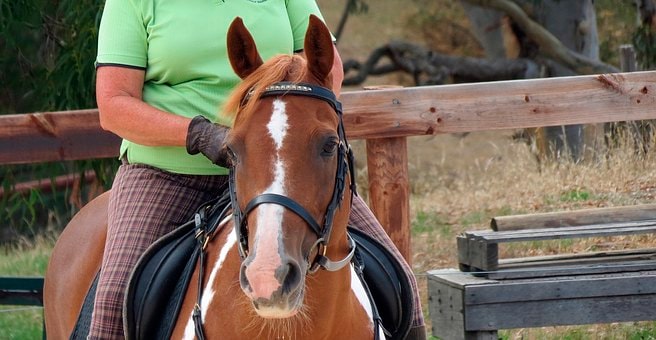
There are two main issues to address:
- What is the capacity of a horse to carry its own weight, in addition to the weight of the rider and his or her mount, without damaging its present and future well-being as a result of the type of activity we do riding it?
- How can we determine the maximum weight a horse of a given weight and conformation can carry to bear that load without future consequences?
To address the first question, let's establish some criteria to take into account.
We must bear in mind that there are two individuals involved who are working together.
Rider and horse, and therefore the physique of each is important, in terms of their conformation and physical condition, in both cases.
The physical conformation and physical condition of both individuals are important.
In the case of the horse
- Physical structure is a determining characteristic, in terms of bone and muscle mass, to carry a load in the different gaits of the horse (walk, trot and canter), for a certain period of time without interruption, and the periodicity of repetition of the effort over time.
- The other requirement is that this structure, like any biological structure, especially the muscular part, tendons and ligaments, is correctly nourished and adequately trained to perform efforts, and thus avoid breaks or tears in these muscles, tendons and ligaments.
- Diet and training influence bone structure in that they favor the functioning and condition of the joints, improving bone compactness and avoiding osteoporosis, arthritis and other ailments.
- In addition, physical condition provides the total structure (bone, muscle, tendons and ligaments) with the flexibility necessary to find balance, to transport itself and the rider.
In the case of the rider
- His physical structure will basically determine his weight.
- The right physical condition will give him the capacity for movement and flexibility to find his own balance without tension, to be able to adapt to the movement of the horse, in any of its gaits, without altering the balance of the horse, with his own weight, plus that of the rider.
This question of the physical structure and physical condition of horse and rider will be seen to be decisive in resolving the two questions posed at the beginning of the article.
General Issues
- I will raise a series of general issues, linked to the most relevant aspects to be taken into account, always supported by scientific knowledge, to answer question 1.
- To address question 2, I will present the calculation formulas, and a very brief sample of the most outstanding studies on the subject, in the field of academic science.
- I will conclude with a summary of recommendations, which of course will be under constant review, as there is still a long way to go to achieve greater clarity on the subject.
Question 1: How much do riders weigh?
In reality, this is an unknown factor that has been little studied and that it would be important to know in order to address the issue.
However, a study was carried out at the University of Cornwall in England to determine the reality of the riders' weight.
The study was carried out on a significant number of riders.
The following was discovered as a result:
- The average percentage of the rider's weight in relation to the horse's weight varied between approximately 14% and 17%.
- With this data we could say that any guideline set for the weight of riders in the UK, set below these values, would be unenforceable, for the simple fact that most riders would have to go on a diet to lose weight, which would make the measure unrealistic.
The results were:
- 5% of riders were below a Rider Weight/Horse Weight ratio of 10%.
- 63% of riders were within a Rider Weight/Horse Weight ratio of between 10% and 15%.
- 31% of riders were above a Rider Weight/Horse Weight ratio of 15%.
**Are there any recommendations or guidelines on rider weight? **
A lot of work has been done on the issue of horse welfare, but little mention has been made of the impact of rider weight on the horses being ridden.
Among those who have addressed the issue, I will mention the ISES (International Society Equitation Science) who discuss the matter on their website stating their position on the matter, in addition to having addressed the issue at their 2019 annual conference held at the University of Guelph.
A book published by the Dutch Equestrian Federation, called “Horse and Welfare”, mentions that the weight and physique of the rider influence the selection of the horse to ride, but does not give further specifications on what the weights or relationships of this data should be with respect to the weight of the horses.
This lack of concrete directives reveals the difficulty in establishing the optimum rider/horse weight ratio, among other things due to the influence of other characteristics, which we will see later, and which influence, in order to give specific ranges of this ratio.
In the USA there is a directive from the US Army quoted in a book called: “The Cavalry Manual for Horse Management” from 1941, which establishes that the weight of the rider, plus his mount, should not exceed 20% of the weight of the horse, a recommendation that must have arisen from the experience gathered in the war, with respect to the overloads on the horses, which could not keep up with the pace of work.
The function of the horse's back
When discussing the question of the maximum weight of a rider for a given horse, it is important to know and understand the biomechanics of the horse's back.
The horse's back transfers its own weight and that of the rider, to a greater extent towards the front limbs, and to the rear limbs, by means of a suspension bridge principle, represented by the tension caused by the lifting of the vertebral apophyses, the spinal suspensory ligament and the upper neck muscles that form the Main Support System.
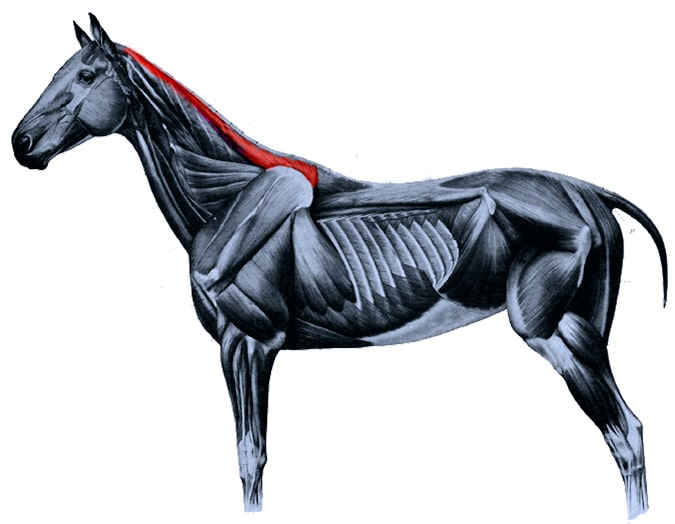
It was believed, until scientific research clarified it, that the spine was rigid and that it transmitted weight to the support system or limbs of the horse as if it were a beam, this concept also leading to a misinterpretation of the action of the upper dorsal and abdominal muscles, thinking of them as support muscles and not as movement muscles, free of tension, as they really are.
The spinal column is not a rigid element, but is flexible, moving alternately to the left and to the right, with respect to a median vertical plane, due to the mobility between the vertebrae.
For this reason, the concept of straightness in horse riding can no longer be interpreted as a literal question of rigid straightness, but as the concept of undulating symmetry to the left and right.
In this sense, horses are born with a dominant asymmetry that produces asymmetrical muscular development, to which is added the asymmetry introduced by the weight of the rider.
This is why we must exercise, through correct riding, a muscular development that allows the horse to adequately carry its own weight and that of the rider towards the limbs, reducing asymmetries.
This has to do with the rhythm of each stride of the horse, and will also have a more or less harmful influence on the horse's muscles and ligaments, depending on whether it is ridden correctly or incorrectly.
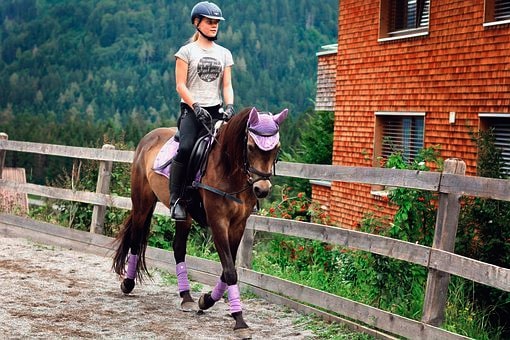
For this last reason, referring to the rider's correct riding skills, it becomes more difficult to establish direct relationships between rider weight and horse weight.
Also, the horse's loin is connected to the back and the pelvis, and these have left and right mobility, depending on the movement made by the horse, allowing these movements of the back and pelvis, which enable the horse to take steps, in any of the gaits, more or less long, when changing direction or turning.
The lack of rotation or rigidity of these structures, added to the sinking of the back, making it impossible for the rider's weight to be adequately transferred to the limbs, produces muscular tension, which leads to back or pelvic pain.
Ethological signs related to back pain
These signs may be caused by excessive and constant loading. They are:
- Arching the back and pulling the ears back, or trying to bite, when the girth is adjusted.
- Swallowing air when the girth is adjusted or when being mounted.
- Difficulty in relaxing the neck.
- Constantly moving when not being mounted.
- Sinking of the back when being groomed.
- When being ridden, wanting to move very little or, on the contrary, not wanting to move at all.
If one or more of these signs appear, do not diagnose on your own. Call your vet so that they can identify the cause of the symptoms.
The diagnosis may come too late, as the horse conceals its possible ailments due to its prey status, and it is very likely that the same may coincide with the excessive weight with which it was ridden.
Question 2: Is it possible to calculate the weight a horse can bear using a formula?
Although we have said that research is needed to determine this relationship, here we are going to give a formula developed by zootechnicians R. Baron and J. Crevat to calculate the weight that a horse's back can support.
To do this we need to measure the height at the withers (H) and the girth of the chest (GC), both parameters expressed in meters (m).
Then we apply the formula that gives us the weight that the back can support:
Weight (Kg) = (56x (CT (m)) 2)/W (m)
Remember that this is an approximate way of answering the question regarding the weight a horse can bear, since, as we have said, this depends on several factors that interact with each other.
We clarify that this calculation of weight refers to the total weight to be supported by the horse, which includes the weight of the rider, saddle, saddlebags, etc.
Academic research to study the effects of load on horses
A) Studies at the California Polytechnic University
At the California State Polytechnic University in Pomona, research has been carried out into the different physiological changes that occur in horses when they are subjected to variable loads.
PhD Steven Wickler, head of the research group, said that their research dealt with energy issues, in order to quantify the costs of carrying weight.
Among these areas of research are questions regarding how weight affects equine biomechanics, metabolism and potential strength.
The research has direct implications for elite sport horses, especially showjumping, racing and endurance, but it also covers everything from the saddles used to horses used for recreational riding, or so-called “garden” horses, such as small horses or ponies.
How much weight is too much?
The answer is “it depends”. However, being aware of the problem of added weight is important for the welfare of the horses.
- **Loads and Safety Coefficient: **
All living beings tend to balance their energies; their survival depends on it. Therefore, they consume energy in their muscles to jump, fly, run or climb, to stay out of danger.
For this nutritional reason, or because of the metabolic costs associated with maintaining their bodies, animals only build up enough muscle and bone for what is necessary, leaving very little margin for reserve, or safety coefficient, for an emergency.
In biological systems, the total integrated safety coefficient does not exceed 2.
The excess weight that the horse may carry is outside this coefficient.
- Metabolism:
The researchers measured the amount of oxygen consumed by the horses on a treadmill at different speeds and, as the speeds increased, so did the amount of oxygen, which was to be expected.
When they began to add additional weight, equivalent to 19% of the body load, which can represent a rider of about 68 kg plus the saddle, the metabolism increased on average by 17.6%, which is equivalent to saying that the increase in metabolism, or energy expenditure, is directly proportional to each kg of load that is added, all this in easy and flat terrain.
This means that the greater the load, the more food.
- Economy:
In horses that can freely choose their own speed, the speed tends to be reduced by the effect of the weight added to their backs.
After carrying out the corresponding tests with a total of seven horses, including geldings and mares, and measuring speeds at walking and trotting paces, with loads of up to 19% of body weight, and without it, it turned out that the speeds adopted by the horses decreased by 5.4% for loaded speeds, compared to unloaded speeds.
But the most important thing was to discover that the preferred speed chosen by the horses, in the case of being loaded, turned out to be the most economical, in terms of energy expenditure, to move a certain distance with a given load.
- **Force on the limbs: **
When the horse is loaded, it produces an increase in the reaction on the ground and in the backward thrust energy of the sole of the foot when it touches the ground, with which each limb is subjected to, in each step.
If the horse were standing still, the excess weight we add is divided between the four limbs.
But in the gallop, for example, not only do the forces increase, but at some point in each stride, the entire weight is supported by some limbs individually.
To find out how horses compensate for these changing forces, tests were carried out on a force measurement plate, both in a horizontal position and at a 10% incline.
In the case of the horizontal position of the force plate, it turned out that the front limbs supported 57% of the force and the hind limbs 43%.
When measurements were taken on an inclined plane, as mentioned above, the force pattern changed to 52% on the front limbs and 48% on the hind limbs, with the support time also varying.
- Gait:
By studying the biomechanical effects of loads, through measurements on horses trotting on a horizontal plane without loads, and on another with a 10% slope without load and on the horizontal plane with load, equivalent to 19% of their body weight, they were able to verify the following:
- Carrying a load meant that the horses left their feet on the ground 7.7% more, on average, while carrying a load than when they were not carrying a load.
- While trotting on a horizontal plane with the overload, the swing phase of the stride was shortened by 3% of the time.
- When the same test was carried out on a sloping plane, the overload meant that the same phase of the stride lasted 6% longer.
In conclusion, all these adjustments to the gait work together to try to reduce the forces exerted on the limbs with each step.
Is the path difficult?
Let's say that the changes or ways in which horses respond to the weight added to their backs are subtle, perhaps too slight to cause serious damage under normal circumstances.
This research, explains Wickler, gives us the framework to understand how adding loads to the horse significantly increases the forces that its limbs must bear.
When the feet hit the ground, the forces that are generated are absorbed by the bone and ligament system.
What these two systems do not absorb must be absorbed by the muscular system, and if it is not in a position to absorb that increase in force, the limbs will break.
Perhaps adding 10% overweight does not cause any damage, but if you carry it during a 160 km journey it can be very significant.
The same thing happens in a racehorse with a small overweight, this is strongly magnified by the dynamic forces that are generated in the limbs, due to the high speed they develop in the canter.
As it is still difficult to establish maximum weights with accuracy, at least for all breeds and types of horse, let us at least be aware that weight influences the future health of our horse.
If, by the way, we go on a diet to be at our normal weight, it will do us and our horse good.
B) Study published by the BEVA
The British Equine Veterinary Association (BEVA) has published a study in its journal Equine Veterinary Education (EVE) carried out by: S. Dyson, AD Ellis, R. Mackechnie-Guire, J. Douglas, A. Bondi, P. Harris.
This study highlights the need not only to correctly match the size of the horse with the weight and physical condition of the rider, but also emphasizes that the fit, or the way the saddle sits on the horse's back, has a very important effect.
The director of the study, Dr. Sue Dyson, commented that the results clearly indicate that each rider, especially the heaviest ones, should ride horses of a size and physical condition appropriate to the rider's weight, using a saddle that fits correctly for both horse and rider.
The researchers stated:
“In conclusion, we have demonstrated with absolute clarity the detrimental effects of inappropriate rider size and weight on equine gait and behavior.”
They further stated that the results indicate that heavier and/or taller riders can magnify any adverse conditions of a saddle that is not suitable for the horse or rider.
C) Study presented at the annual ISES 2019 conference
The ISES (International Society for Equitation Science) comments on its website that there are studies that indicate that the physiological parameters and symmetry of the gait are affected when carrying heavy riders, especially when the rider's weight to horse's weight ratio increases from 20% to 35%.
Dr. Janne Winther Christensen, from the University of Aarhus in Denmark, and her research team analyzed the consequences of a sudden weight increase on the horse's behavior, physiological responses and the symmetry of its gait.
The results of the study were presented in August 2019 during the 15th annual ISES Conference held at the University of Guelph.
At the presentation, Christensen said:
“The effect of rider weight on horse welfare is hotly debated and is likely affected by a number of factors, including horse type, work intensity, horse training level and rider skills.”
The study included 20 rider and horse combinations, all of which performed a standard dressage test.
The riders rode without additional weight and with an additional 15% or 25% of their body weight, which was added to a vest worn by the rider.
The maximum ratio of Rider Weight to Horse Weight was between 15 and 23%, with the intensity of the exercise being moderately low.
Based on these results, Christensen stated that within these weight ratio ranges and in light to moderate exercise, sudden increases in the rider's weight did not induce changes in the parameters analyzed.
D) A study of Japanese origin
Horses may look strong, as do humans, who may have muscles or good bone structure, but not all of us can lift any weight, this also depends on other factors.
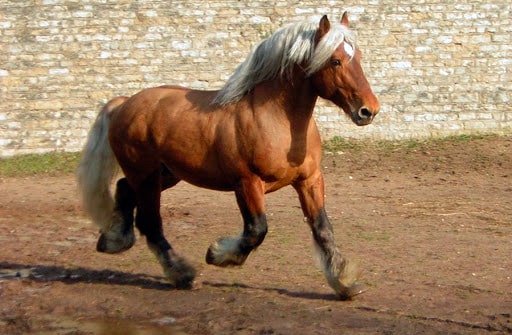
In the case of what is the maximum weight that a horse can carry, we have already mentioned that it depends on several variables, such as bone conformation, muscle structure, breed, types of work, etc., which makes it difficult to determine a single maximum weight for all horses.
To contribute to this subject, we will mention a study carried out in Japan, more precisely at the Faculty of Veterinary Medicine of the University of Kitasato in Aomori, which was directed by Professor PhD Akihiro Matsuura.
The study establishes a way or method to determine, or to be able to know, if a horse is overloaded.
The study found that measuring the symmetry of the gait, that is, the uniformity of the steps on each side (left and right) and during a repetition of several steps, allowed scientists to gather information about the load or weight that horses can carry.
The researchers concluded that out-of-sync steps are a strong indicator of the load a horse can carry.
At a trot, the symmetries for loads of 100, 110 and even 125 kg turned out to be significantly lower and more disparate than those of the initial test of 80 kg, which led the researchers to conclude that the maximum permitted load should be less than 100 kg, which represents 29% of the body weight of the horses in the study.
A similar study could be used to determine maximum weights for different breeds and types of horse.
Details of this study can be found on the website: pubmed.ncbi.nlm.nih.gov
Final conclusions
Here we are going to try to summarize the topics covered in the previous points and which we should bear in mind when analyzing the two questions, which we have proposed in this article, referring to the unknown of the weight that a horse can carry, in order to avoid future disorders in its performance.
The size of a horse
When we talk about the size of a horse we are referring to three variables: weight, height and girth.
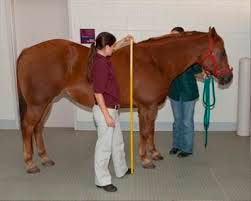
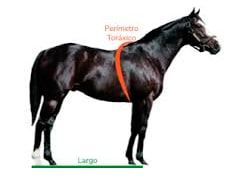
Weight and height depend, to a large extent, on the breed to which the horse belongs.
As a mere reference, we can mention that a Purebred Arabian weighs around 370 to 440 kg and stands 1.43 to 1.52 m tall.
The English Thoroughbred weighs between 490 and 510 kg and stands between 1.6 and 1.75 m tall.
If you don't have a scale to weigh your horse, you can make an approximate calculation using formulas that are linked to height and chest circumference. All you have to do is take these measurements of your horse and, depending on its age, use the following formulas:
For an adult horse (over 4 years old):
P (kg) = (4.3Chest circumference (cm)+3Height (cm)) - 785
For a young horse (under 4 years old):
P (kg) = 4.5*Chest circumference (cm) – 370
The rider's weight and seat
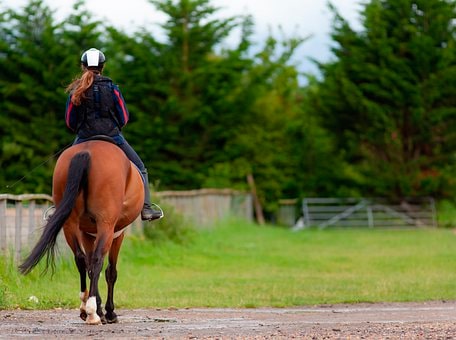
The weight of the rider, which depends not only on his or her height, is important, but perhaps more important than the rider's weight itself is, to a certain extent, the rider's seat when riding.
It is not only the weight that we make the horse carry that matters, but also how we make it carry, or in other words, how the rider distributes their weight over the horse's back through their seat.
Perhaps a 50 kg person who does not ride correctly may cause the horse more discomfort than an 80 kg person who rides properly.
The physical condition of the horse
We would say that a horse is in good physical shape if it trains regularly and is in good general health.
When it trains regularly, not only does it strengthen its muscles and bone structure, but it is also accustomed to the correct position for using its muscles properly.
How much weight can a horse bear?
As we have already seen, there are several factors that influence this, and there are ways of calculating it based on formulas. We have also seen the results of academic research aimed at determining percentages of the horse's body weight, as a parameter, to calculate the maximum weight that it can carry.
We might get the idea that a taller horse will be stronger, but it turns out that the opposite is true: the taller the horse, the more delicate it is in terms of the weight it can carry.
In fact, if we look at the formula for calculating the weight a horse can carry (R. Baron and J. Crevat), we see that height is inversely proportional to that weight, which means that if we fix the chest circumference and increase the height, the weight capacity decreases.
The same formula also tells us that for the same height, the chest circumference is more important, since an increase in this influences to the power of 2, the result of the bearable weight.
When referring to the horse's capacity to carry extra weight, what is more important than the size or height of the horse is its physical condition, whether it is overweight, whether it is in pain, or has any kind of injury.
The important thing for a horse to be able to carry the weight of a rider is that it has a strong back, with adequate musculature, and that it is healthy.
The weight limit for horse riding
We have seen that there is no clearly established limit on the maximum weight, including the weight of the rider, saddle and saddlebags that a horse can carry, as this depends on several variables.
The studies we have shown give different percentages for the weight carried in relation to the weight of the horse, but other important considerations are also taken into account, such as physical condition, physical build, horse breed, etc.
I believe that the Japanese study, if we extend it to the different breeds, would be an adequate way to set maximum weight limits for each breed of horse, with the aim of ensuring the welfare and safety of the horse and also of the rider.
While the studies that will allow us to establish this relationship are progressing, based on the aforementioned studies and on my own experience in breeding and training horses, I would say that it would be very important not to exceed 25% of the horse's weight as the maximum weight limit for transportation.
When I refer to the weight of the horse, I am referring to its correct weight and not to the weight of a horse that is overweight, either because it is overfed or is very sedentary.
It will also be difficult for an overweight rider to have enough momentum to mount and dismount the horse, generating stress in the horse from the beginning of the ride.
Finally, with regard to the question of the maximum weight to be carried, and beyond the type of horse or the qualities of the rider, it is important to bear in mind the topography of the terrain on which one is going to ride, and the gait in which the horse will move.
It will be easier for the horse to carry someone heavy on a flat surface than to go along an extremely steep path.
Also, if you are carrying someone very heavy, it is better to go at a walk and not at a trot or gallop.
I hope these lines will give you some general information on the subject of horses' capacity to carry the weight of the rider, their saddle and saddlebags.
Always take care of this detail, for your own good and that of your horse.
Continúa leyendo
Este artículo es exclusivo para miembros.
To view this blog, please complete the form
Access full content
Comments (0)
No comments yet.
You might also like
Paul Coudenys and Entre Orejas: Unique Horseback Riding Experiences in South America

Why Do Horses Rear Up? Causes and Solutions
Separation Anxiety in Horses
The Evolution of the Horse: Interview with Dr. Marcos Imberti
The Reflection of Human Emotions in Horses: Allies in Assisted Therapy and Equine Therapy



Comments
Leave your comment