
The relationship and communication between man and horse can be misinterpreted in certain aspects. That is why I have written a series of three articles in which I will try to clarify it based on research and studies.
In the first article, published on January 21st, we saw how to interpret the non-nutritive chewing and licking of the horse's lips.
In this second article we are going to try to contrast the influence that the bond between human and horse can have on the equine's behavior.
The third article refers to the concept of leadership and dominance and its derivations in the training or breaking in of horses.
The human-animal bond
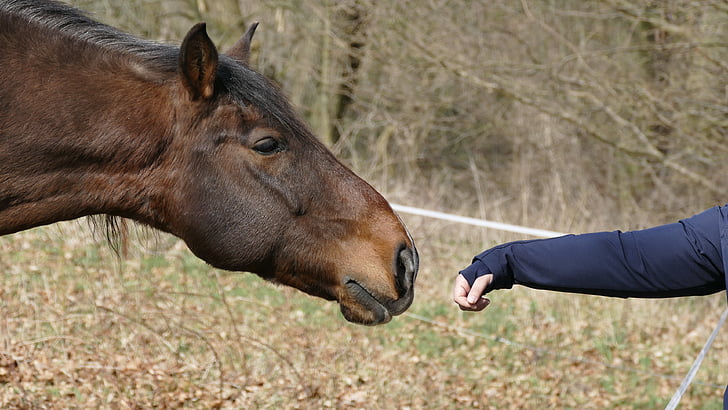
Human beings have the capacity to form emotional bonds with other species, such that animals can develop attachment to humans, attachment being understood as a close emotional bond that makes one individual feel that the other is a figure of reference, a source of emotional security.
This bond between humans and animals is increasingly taken into account, and we find that, traditionally, many consider that this bond provides greater well-being in the animal and helps to improve the performance of those animals used for work.
Attachment, from an ethological point of view, is a behavioral system that regulates an affective relationship between two individuals, in which one tries to stay close to the other, whom it needs as a reference (secure base) for its proper development and well-being.
A clear advantage of this bond would be that the “safe starting point”, also known as a secure base, provided by an attachment figure, is expressed in an improvement in the way a potentially threatening situation is faced.
Although riders of all kinds, both elite and leisure, seek this union with the horse, certain investigations exploring the benefits of the bonds between horses and humans have shown that this is not exactly the case.
Research on the human-horse bond
Next, we are going to determine if the previous statements are true, based on research carried out in the United Kingdom in October 2016.
The title of this research is “Strange danger. An investigation into how the bond between humans and horses influences stress and behavior.”
It was carried out by Carrie Ijichi, Keith Squibb and Rebecca Favier from Hartpury University Centre and by Kym Griffin from Nottingham Trent University.
This research sought to determine whether or not the presence of horse owners, whose “bonding level” is higher than that of other people, will influence the horse's performance and willingness to do what is asked of it.
In other words, they wanted to see if the owner's attachment to their horse led to an improvement in the horse's behavior and a reduction in stress, or if it made no difference and the most important thing was that the trainer was competent.
In short, the study was based on two handling tests. Each test was carried out twice, with the horse's owner and with a professional trainer who had no previous contact with the horse.
A total of 46 horses of mixed breeds and genders participated, ranging in age from 3 to 20 years.
The order of the tests and the person in charge of handling the horse was randomized and they were also “double blind” with respect to the performance of the horse with the alternative handler.
A series of physiological variables were measured to evaluate the responses to stress, and the time taken to complete the test and proactive behavior were also measured, to be used as indicators of performance and compliance.
What conclusions were drawn from this research?
We will develop them in the following sections of this article.
Attachment Theory
Attachment theory, developed by the British psychoanalyst Bowlby in the 1970s, describes the propensity of human beings to form emotional bonds with others and the importance of their development from the outset between babies and their caregivers.
This attachment is not only between humans, but also between other species, such as mammals.
Based on this theory, it is said that appropriate bonds help survival because those vulnerable offspring, in such species, stay close to their mothers.
In the case of domestic animals, as they depend on their human carers, there may be some level of attachment-type bond.
A relationship bond that has fully developed is characterized by the search for proximity, that is, a secure base or secure starting point, a safe haven and, in addition, an anguish over separation. (Mikulincer and Shaver, 2003) “The creation of a bond between animals and their human caregivers is most desirable, as it improves human well-being (Walsh, 2009) and anecdotal evidence shows that it affects the athletic performance of horses.” (Parelli 1993; Roberts 1997) “In competitive horse riding, it is believed that the relationship between humans and horses determines the performance of the pair in those more demanding and pressurized situations.” (Fallis, 2013)
But we must be careful that this relationship between human caregivers and animals does not lead us to confusion and mistakenly think of the overconnection of the animal with the human.
It is true that, in cases such as dogs, the possibility of communication with the carer is greater.
Attachment Theory in horses
In the case of horses, the relationship with their carers is not as close as in companion animals. However, it has been proven that they can identify those humans who have a relationship with them from strangers, provoking different cognitive responses.
But this has not yet been sufficiently investigated.
Familiarity is known to have a positive influence on behavior during horse handling, but the effect of more complex bonds has not yet been evaluated.
For this reason, the research study discussed in this article was conducted.
As mentioned above, the main objective of this research was to determine whether horses respond differently to new handling challenges, depending on whether they are with a very familiar human, such as their owner, or with a stranger.
If a familiar human provides a secure base or starting point, as a result of a human-horse bond, it would be expected that horses would take less time to complete the tests, show potentially less dangerous proactive behavior and have lower physiological stress indicators, compared to when they are handled by a stranger.
The results of the research
They were very conclusive:
“There were no statistically significant differences in behavior or in any indicator of stress, regardless of who was training the horses.”
This means that it doesn't matter who handles the horses, whether it's a familiar human or a stranger, the result is the same.
Therefore, the results mentioned do not support the existence of a “safe baseline” effect of the bond in human-horse interactions.
Details of the research result
Definition of the two cases in which the horse will find itself, depending on who is handling it:
- The owner: as the person who looks after and trains their horse on a daily basis, they will have a greater attachment to it. This logically supposes a secure base or starting point of union through interaction between man and horse
- The trainer or handler: is a person who has not had previous contact with the horse. During the test the horse was separated from its owner. This presented them with a potential threat, without the supposed “safe base or starting point”
The conclusions according to the results obtained are:
It has been verified that in neither case did the horses experience stress, which indicates that neither secure base (Cassidy, 1999) nor separation distress (Mikulincer and Shaver, 2003) were the salient characteristics of the bond in this case. Therefore, horses do not respond differently in situations where bonding is not possible, i.e. attachment does not exist, and they do not become distressed at being separated from their owners, even in challenging scenarios.
There was no difference in the time taken in the test or in the proactive behavior of the horse depending on the handler. That is, neither the performance of the test nor the proactive, potentially dangerous behavior shows a difference between the two horse handlers.
Some training practices with an anecdotal basis, often described as “natural” or “sympathetic” horsemanship, claim that bonding has benefits for solving problems that result from these factors (Roberts, 1997).
They attribute reduced flight responses and improved compliance as a result of trust” or ‘respect’ for a leadership figure.
The current experiment contradicts this and, instead, supports previous research that undermines the legitimacy of such claims (Hawson et al., 2010; McLean and McGreevy, 2010).
For example, it has been shown that horses will follow an unknown person, after “bonding” with a different individual (Krueger, 2007), or even follow an inanimate object (Henshall et al., 2012), inside a round pen.
Furthermore, the changes in behavior resulting from techniques such as round pen interactions do not persist outside this specialized context (Krueger, 2007).
Taken together, these results do not conclusively reject the possibility of bonds between horses and their owners.
They only suggest that certain characteristics seen in fully developed attachments may not apply in any significant way to interactions between humans and horses.
Conclusions of this article
In view of the above, I would say that the most important conclusion to bear in mind is that these findings suggest:
- However, this does not conclusively reject the concept of bonds between horses and owners.
Comments (0)
No comments yet.
You might also like

Paul Coudenys and Entre Orejas: Unique Horseback Riding Experiences in South America

Why Do Horses Rear Up? Causes and Solutions
Separation Anxiety in Horses
The Evolution of the Horse: Interview with Dr. Marcos Imberti
The Reflection of Human Emotions in Horses: Allies in Assisted Therapy and Equine Therapy



Comments
Leave your comment