
Peruvian Paso Horse II - Morphology
The physical appearance of the Peruvian Paso Horse
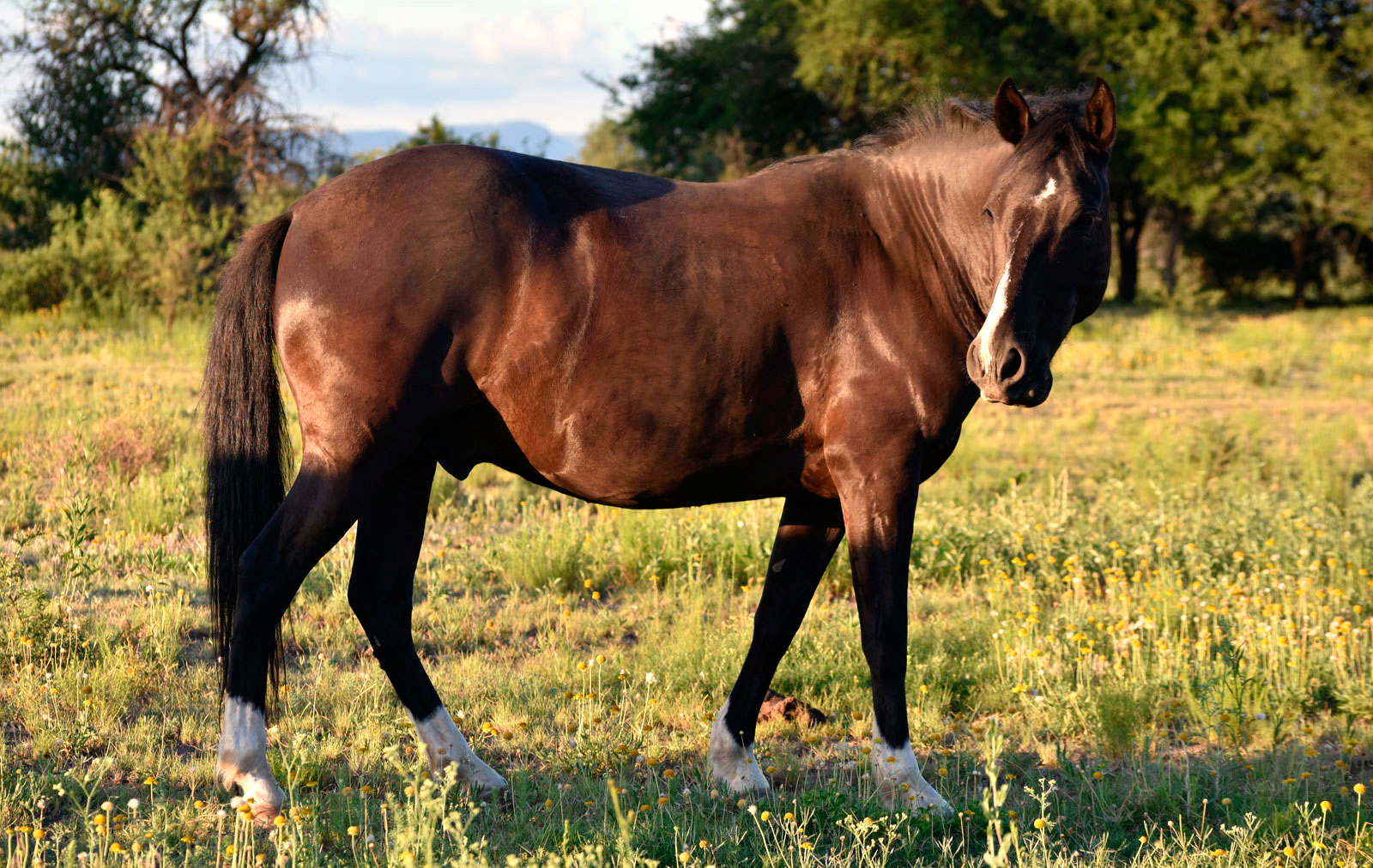
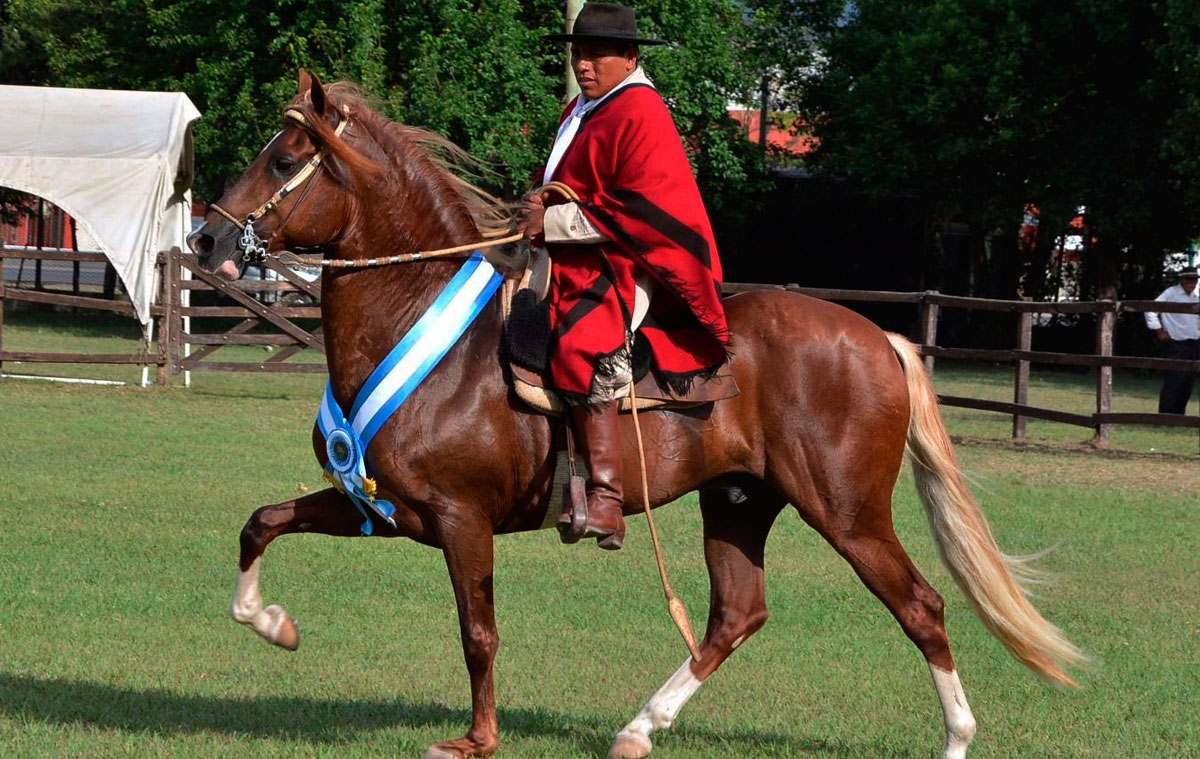
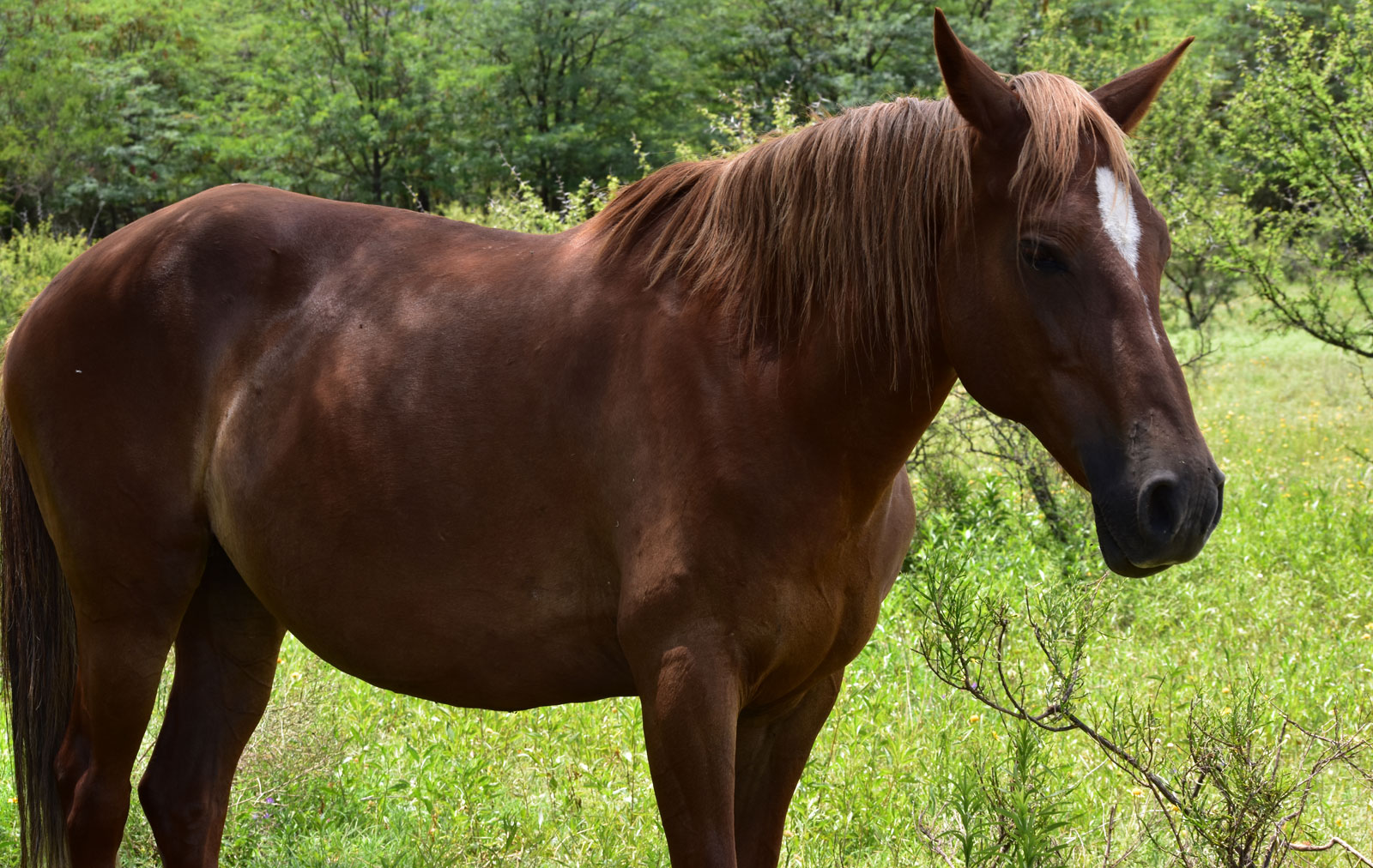
The Peruvian Paso Horse is a medium-sized horse with a morphological harmony that provides an adequate correlation between the different parts of the body, with its own angulations and inclinations, all of them in line with the best bone and muscle structure, to fulfill its main function: To walk at its characteristic pace, which is the Peruvian Paso (known as Pisos), and to travel long distances.
Looking at the physical aspects, in general the Peruvian Paso Horse (PPH) has an average height at the withers of 1.48 m for males and 1.46 for females.
Head
- It is predominantly subconvex in the frontal area, elegant and expressive.
- It has an approximate length of 59 to 61 cm measured from the top or crown of the head to the upper lip, with a width between the ears of 11 to 13 cm and between the orbital apophyses of 16 to 18 cm.
- The forehead is broad and flat and the base is strong with a thin, narrow lower end, with 8 to 9 cm between the ends of the nostrils.
- The ears are medium length and thin, with very lively oval eyes of a dark color placed laterally and obliquely.
Neck
- The neck has an average length of 60 cm measured from the middle of the junction of neck and head to the middle of the back.
- The cervical line is markedly convex in males and much less so in females.
- The lower line of the neck is shorter and straighter in both sexes and the lower end is broad and robust, blending smoothly into the back and chest.
Body
The length of the body should be close to that of the height, that is to say it is almost a square and this is a very important characteristic to avoid “long” horses that complicate the functionality of the gait.
- The length is measured from the shoulder to a vertical tangent to the buttock.
- The height measured from the ground to the sternum should be approximately equal to half the height at the withers, which gives a measurement of the depth or measurement between the withers and the sternum.
This depth gives an idea of closeness to the ground, which is very important for the horse's function and is a very marked racial characteristic. To the extent that the distance from the ground to the sternum exceeds half the height, the horse will appear to be lifted off the ground.
The withers should be slightly higher than the rump (to form what is known as an uphill horse) and if we join these two points with an imaginary line, we should get a catenary with the line of the loin of no more than 8 cm at the lowest point.
The chest will be robust and broad, around 34 to 36 cm, and the back should be moderately short and slightly straight, well joined to the front third and the lumbar region, with a broad and deep ribcage and the sub-sternum parallel to the ground.
The loin, short and well joined to the back and the rump, should have good muscle coverage.
The rump is round, broad, proportionate and with an inclination that marks a low birth of the tail or tail.
This low-born tail, with long, abundant and fine manes, should be kept still and close to the buttocks when walking, this being a characteristic of the breed.
Limbs
In the previous members, a long back is highlighted, with an inclination of between 58º and 62º with respect to the horizontal plane, short and muscular upper arm and long forearm (39 to 42 cm) and muscular on top and thinning downwards.
The knee is well defined, broad, without deviations and the anterior face is slightly convex.
The cannon has a length of between 26 and 29 cm with a circumference of between 17 and 19 cm.
It is important to emphasize that the ratio between the thoracic perimeter and the cannon perimeter should not exceed a ratio of between 9 and 10.
The fetlocks are clearly defined and the pasterns should be solid and have a perimeter just one centimeter less than that of the cannon bone and an estimated length of between 9 and 11 cm.
In the hindquarters, there is the “motor” of the CPP and as a whole it should be seen as powerful for propulsion and with the capacity to contract and expand, a rounded buttock with a moderately muscled thigh and a strongly muscled lower leg.
The hock should be clean and molded, with a strong bone structure. It forms an inward angle, which we call the bend, and should range between 137º and 142º. This bend is a characteristic of the breed.
And as for the posterior shank, it should be clear, clean and with strong, well-inserted tendons and a perimeter ranging from 18 to 20 cm.
The posterior knot is similar to the anterior one and the posterior pastern should be solid with a perimeter of 17 to 20 cm and a length of 9 to 11 cm.
The Hooves
The hooves are proportional to the animal's body and are well developed.
The sole of the foot is concave, with a long and wide pad, the horn is hard and resistant and the wall of the hoof has, at the front, an inclination of 48º to 51º to the horizontal and the axis is a projection of the pastern and the length is about 8 to 10 cm in the front hooves.
The hind hooves have small differences with respect to the front hooves.
Legs
- In a frontal view, as in all breeds, the median axis should be an imaginary straight line perpendicular to the ground, dividing the forearm, knee, cannon bone and hoof in half. The particularity in the CPP is that the hooves of the hind legs are closer together than the hooves of the front legs, if we look at them as points on the ground they would form a trapezoid.
- In a rear view the axes follow the middle parts of the hock, cannon, pastern and hoof.
- In the lateral view, it is a racial condition, the hooves are tucked under the body mass giving the forelimbs a view of them, slightly tucked in and the hind limbs are seen to be angulated and the perpendicular line going down through the edge of the buttock should touch the point of the hock, which, from the angulation of the latter to the support on the ground, and thus in this view, the whole of the forelimbs and hind limbs gives us a tra pezoidal.
The passion that characterizes CPP enthusiasts, be they breeders, owners or riders, is very strong and special, and this is due to the special condition of the breed, due to its origin as a pure breed not mixed with others, but rather evolved from a single genetic nucleus, with man and the environment of the territory, its climate and pastures, being the factors that, by unnatural selection, produced its unique, smooth gait, and its morphology, also unique, which allows it to walk long distances.
This special character of uniqueness, which gives us the sensations and emotions produced by a unique jewel, is what explains the passion of enthusiasts.

If we can make the CPP known to the whole world - by showing it on a horse trail or horseback ride, so that it delights its rider and allows him to enjoy stress-relieving nature - the passion is doubled.
The raison d'être of the CPP, we at Ampascachi believe, is the smoothness of its gait and its stamina for long distances, and to top it all off, the elegance of its movements makes all eyes turn to the horse and rider, and this is flattering. It is a plus that the experience of riding a CPP gives us, it is the breed with the brightest future in the present and the future.
Do you have any experience with the Peruvian Paso horse breed? Have you noticed the difference in their gait? Tell us about your experience!
Continúa leyendo
Este artículo es exclusivo para miembros.
To view this blog, please complete the form
Access full content



Comments
Leave your comment