
Peruvian Paso Horse IV - The dromograph
The dromograph
In the dromograph, the order in which the hooves reach the ground is considered and the time of support is taken to be equal to the time of lift-off (limb raised from the ground).
The order of arrival on the ground is a beat or “time” which, as the horse has four limbs, is four beats and this marks a rhythm, as in music, and when walking at a pace the horse moves one limb at a time and also settles it one at a time, marking that rhythm.
As can be seen in drawing No. 1, for pure ambling (Huachano in Peru), we have only two beats, the drawing shows, lateral biped supports on one side and suspension of the lateral bipeds on the other side reaching the ground at the same time, with moments of double support.
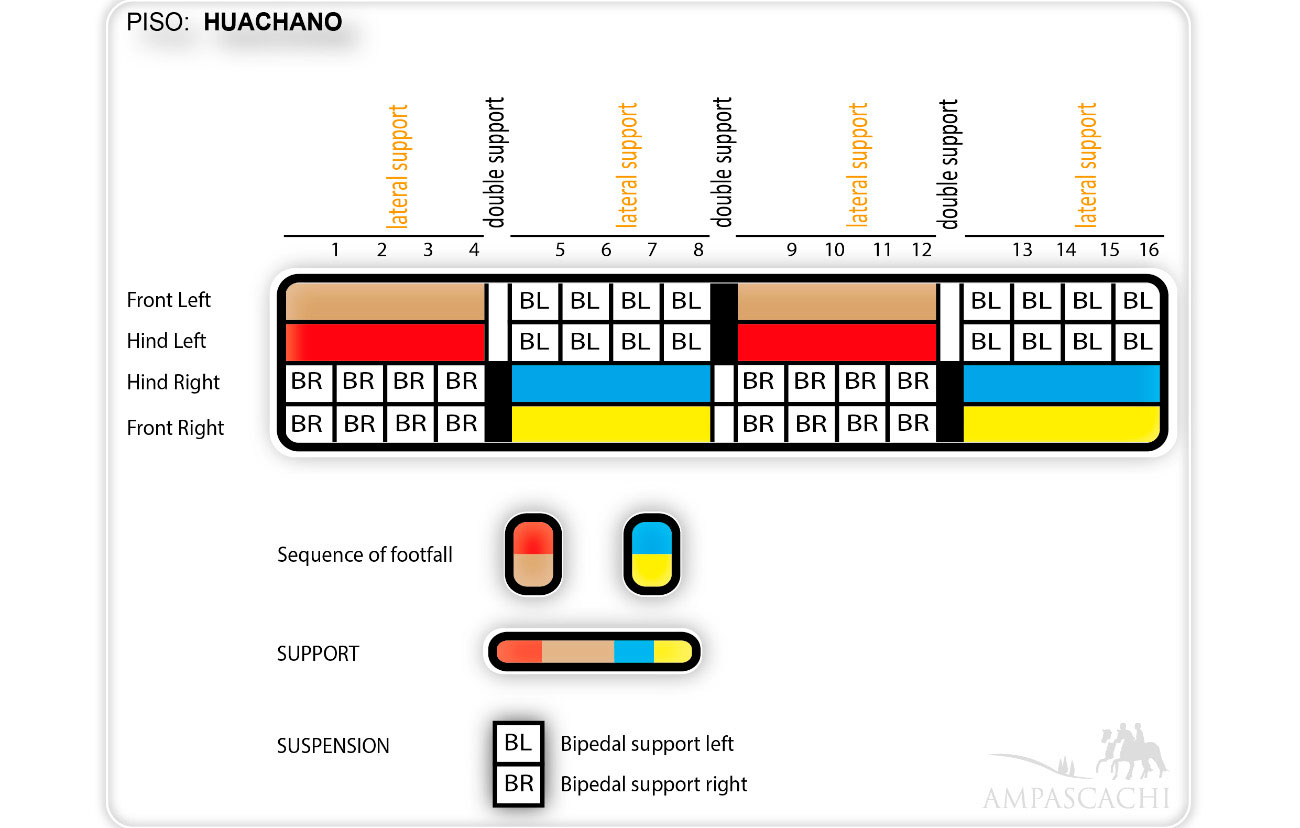
The two lateral strides are clearly visible, due to the simultaneous support of the bipeds and this is why ambling is classified as a lateral trot, with the advantage that the simultaneous suspension of two limbs is not done with an upward movement but to the side and this produces what we have called the hammock component.
This movement, which is also uncomfortable, is less abrupt than vertical or diagonal jogging.
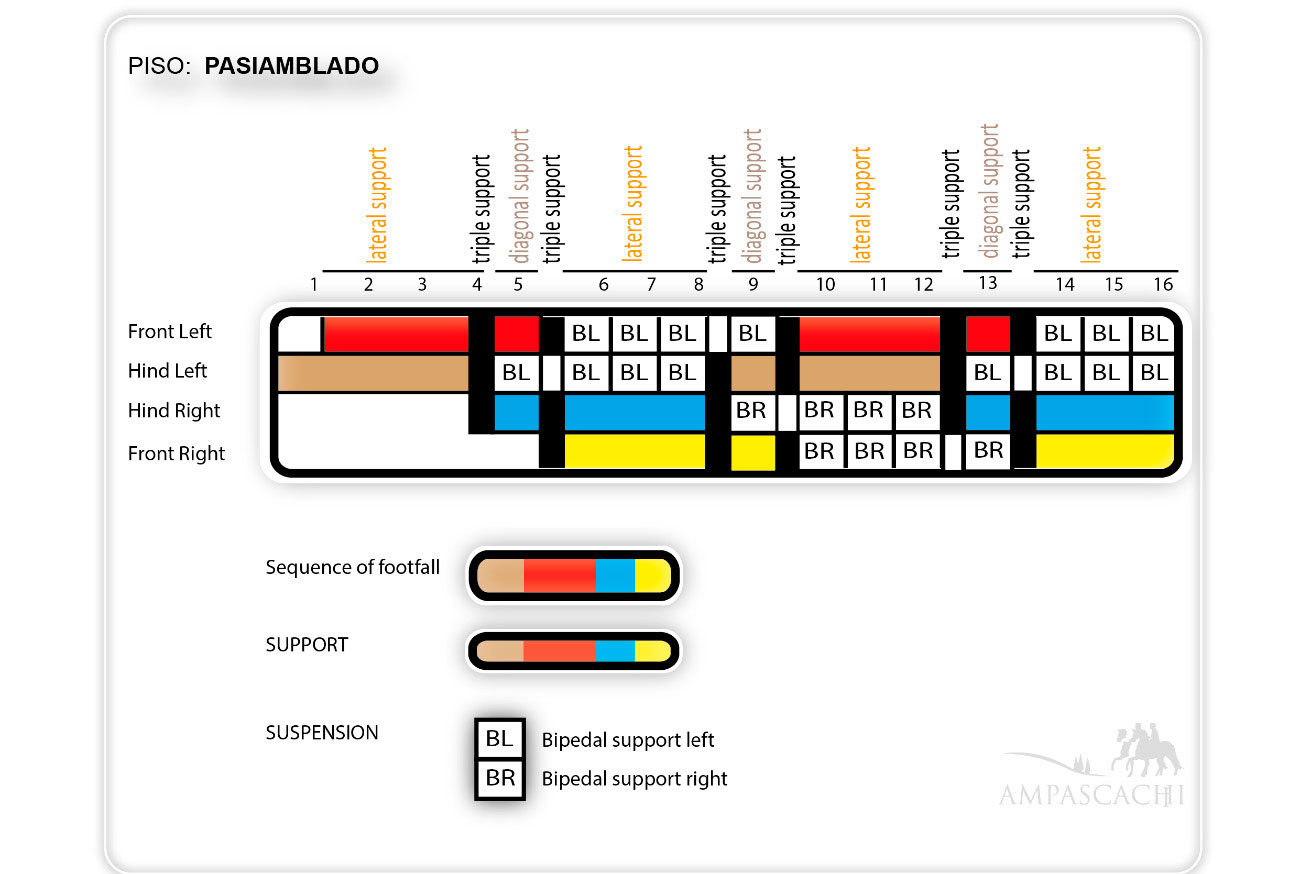
In the case of drawing No. 2, the dromograph shows us the basic step of the pasiamblado, which, due to the delay in the arrival of the previous member on the ground, causes the dissociation of the ambladura and the snapshots of three supports and lateral biped supports lasting three beats and diagonal biped supports lasting one beat appear, as can be seen graphically we are faced with a four-beat execution, but with an asynchronous rhythm, we could say a rhythm of unequal beats, or rhythm with a pause.
We will say for this base step, called pasiamblado, which is the most finished representation referring to the step of a CPP, because to achieve this, the horse must put its hind leg well below the mass of its body, stretching it in such a way that, without reaching the same time as the front leg reaches the ground, as in the case of pure amble, it only dissociates one beat.
This asynchronous movement shows a forward movement with fewer beats to cover the same distance as the other instances of dissociation, such as the Paso Llano and the Pasitrote.
However, let's not forget that the raison d'être of the CPP is to travel and for this the Paso Llano base step fulfills this traveling expectation with great comfort for the rider.
Although the horse in Paso Llano does more beats than in Pasiamblado, the effort it makes is less than in the latter basic step, giving sufficient comfort, poise and management of the momentum.
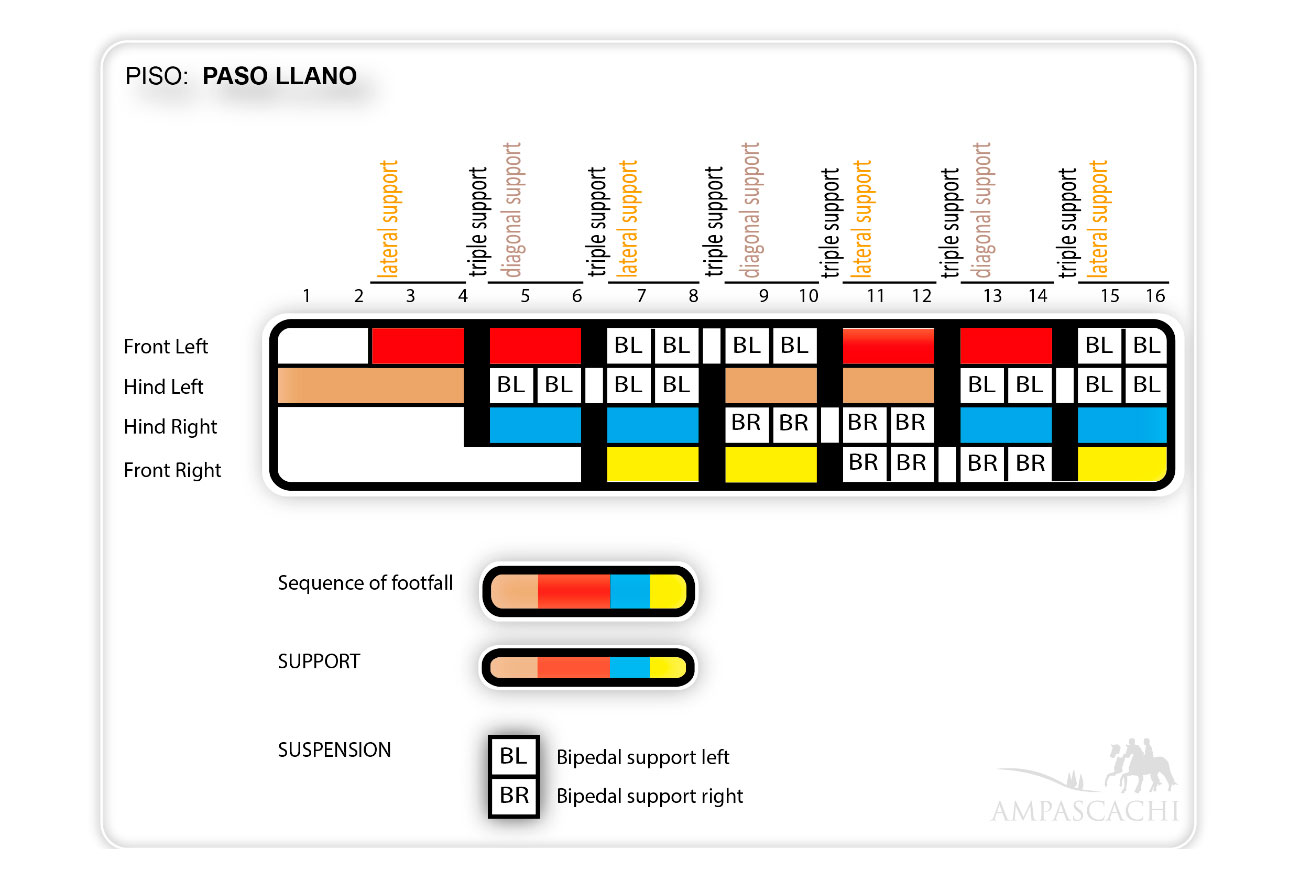
As can be seen in drawing No. 3 of the dromograph, the Flat Step is synchronous, as it can be seen that the delay is two beats and therefore the support time of lateral bipeds and diagonal bipeds are the same.
Some might say that the mechanics of the gait, which consists of moving one limb at a time, raised and supported, marking four beats, as is the case with the flat walk in the CPP, is a gait common to all horses.
In response to this we will say that it is true, in terms of timing or rhythm, but none of the other breeds can do it at speeds of 10 to 15km/h and that is where we point out that the CPP and other gaited breeds can do it, with the caveats we have mentioned about them in terms of trotting, because that gait, which we call Paso Llano of four synchronous beats per stride at speed, is specific to the CPP and is derived from dissociating ambling, that is to say, it can walk like this because it has the genetic basis of ambling.
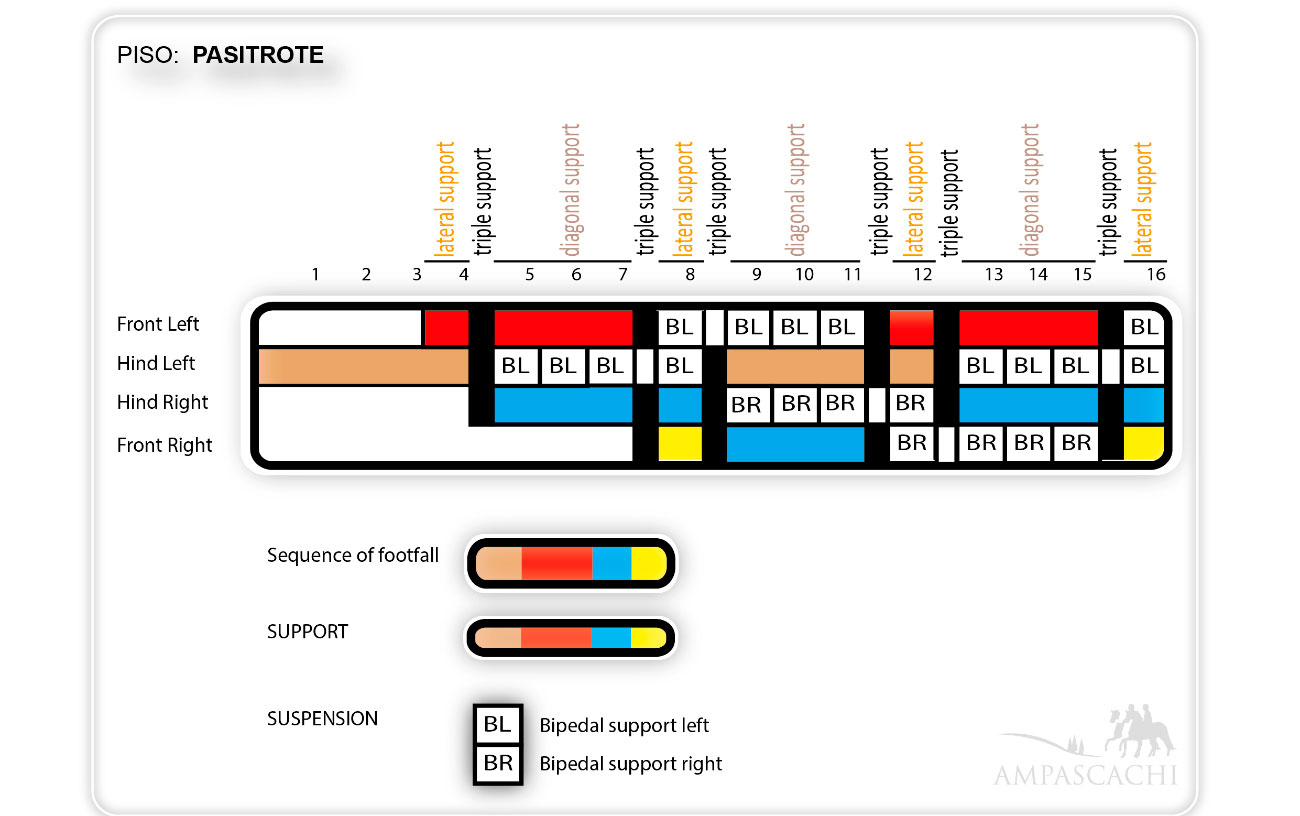
In drawing No. 4 of the dromograph we can see that the delay of the hand is three beats, presenting support of diagonal bipeds of three beats in duration, with which we see how we evolve towards the diagonal trot of the following drawing No. 5 of the dromograph.
Of course, in this basic Pasitrote gait, vertical components of the movement are present, obtaining what is known, among CPP enthusiasts, as a rough or ordinary horse, lacking in breed, since it is evident that we are at a single tempo, of the diagonal trot.
This situation occurs in many of the other gaited breeds where ambling is not predominant, as a breed background, and of course it is more difficult to dissociate what little there is, as it coexists with the neural connections of diagonal trot, and for this reason more important work has to be done by the rider to take these gaited breeds into four-beat time, avoiding diagonal trots.
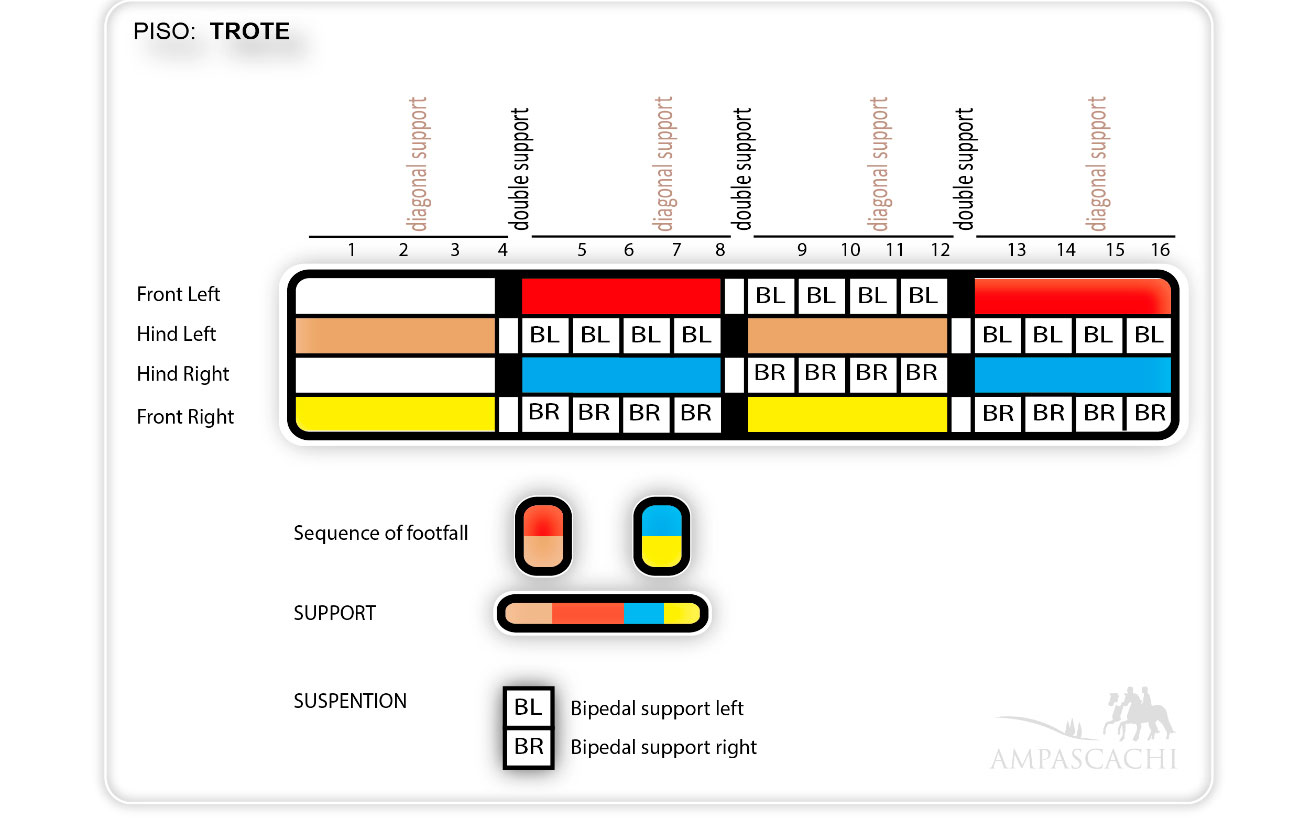
Finally, drawing No. 5 of the dromograph shows that, by dissociating the four complete strides, the horse no longer unbalances its weight on the side, but must rise vertically (see the animated drawing of the trot) and produces diagonal and simultaneous bipedal supports of double support, thus returning to a two-stride movement, like that of ambling, but with the great difference, that as the simultaneous support of the legs is diagonal, the horse necessarily has to move vertically in order to advance, producing for this air, which all breeds of horses have, even the Paso, with the exception of the CPP, a greater strain on the rider.
It is important to emphasize that in the animal kingdom, homo sapiens included, as the speed of gait increases there is a marked tendency to lengthen the stride, because although the beats can be increased, it is easier to increase the speed by lengthening the stride, which is why increasing the speed of the horse's gait increases the length of the stride, reaching a pasiamblado but at high speed, and this is why the horse must show , as indicated by the rider, that it can stretch or amble at a low number of beats or low speed and that is where the quality of the horse within the breed is shown.
Of course, when asked to go faster, to the extent that it is possible to achieve a canter by increasing the strides to the maximum, the horse will fall into the two-beat amble, and it is at this point that the rider must be alert and maintain the four beats, to avoid falling into the amble.
Beyond this point, if we ask for more speed, it will happen like any horse in a canter air (three-beat air).
The CPP's gallop
Here we will make a brief comment to answer a question that is always asked: “Does the CPP gallop?”
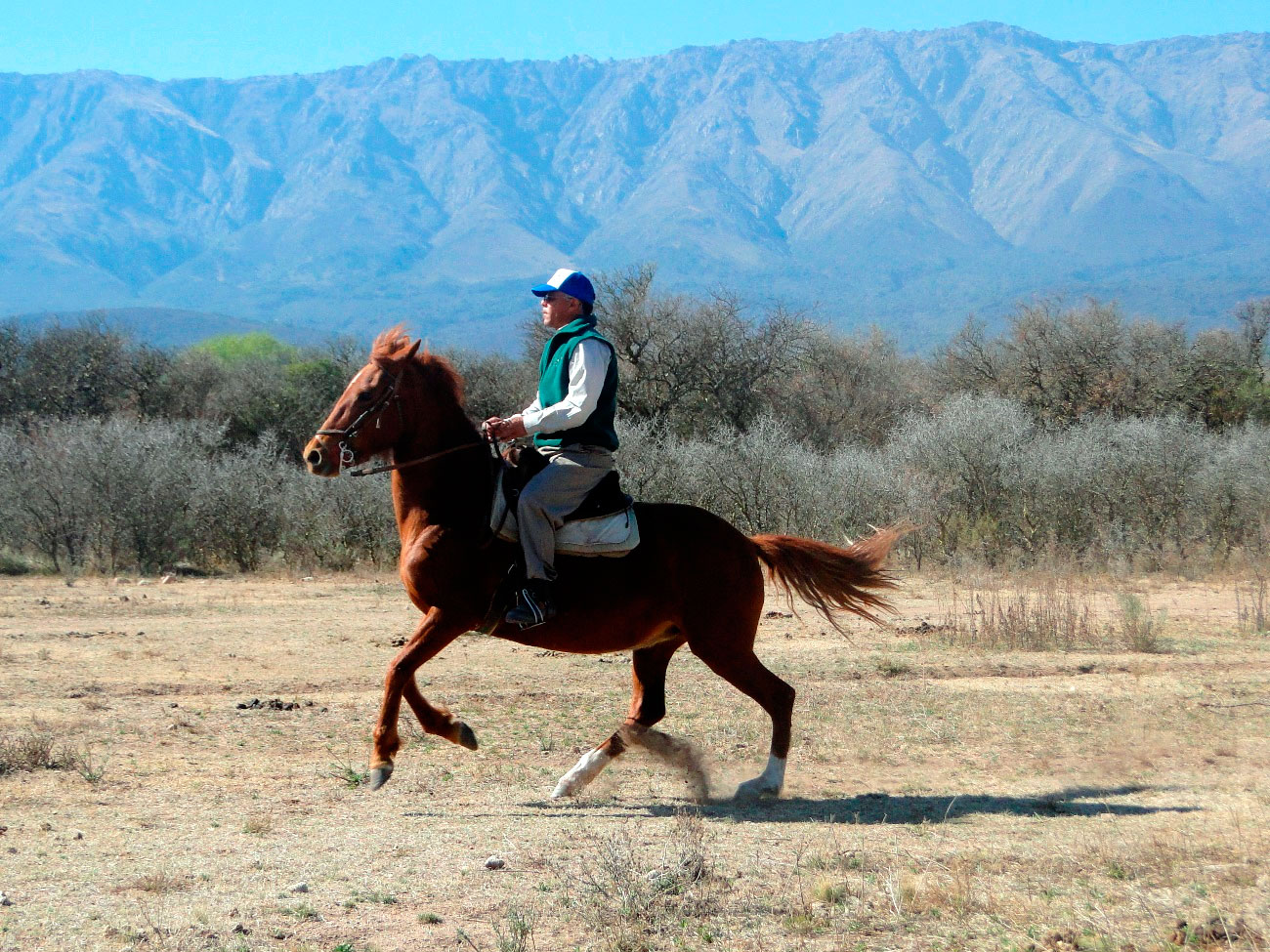
The answer is a resounding yes, because if it didn't it wouldn't be a horse, as it evolved by outrunning its predators through the flight instinct that manifests itself with an acceleration of its limbs until it develops the gallop that quickly takes it away from the predator.
What happens is that many breeders think, wrongly in our opinion, that if the canter is practiced, this can be detrimental to the horse's gaits, and therefore, when training their horses, they do not teach them to canter correctly.
This concept, with respect to galloping, is absolutely false. The horse must be well trained so that the rider always has his or her limbs under control of the stimulus produced by the aids, that is to say, it is a question of the correct application of the training technique.
Furthermore, galloping strengthens different muscles of the horse and especially its tendons and joints.
Equestrian tourism clients like to gallop on their routes and our CPP must meet this expectation.
Therefore, at Haras Ampascachi, we train our CPPs including the correct teaching of the canter, practicing it constantly.
Remembering Don Luis de Ascasubi, we will say like him that it is the amble that gives the CPP its thoroughbred character and that it is what characterizes it as a mechanical principle of movement, but it is the dissociation or breaking of that amble that must occur so that we can advance at the four tempi that we aim for, and thus seal the selective process represented by the levels of the CPP.
We repeat that the CPP is unique, compared to other breeds of paso, due to the cadence in the execution of each movement to achieve the four beats, the advance it achieves in each beat, the impulse given by the subsequent beats, typical of the verve of the breed, and the elegance of its gait produced by the freedom with which its front legs move, stretching out, as if it were a freestyle swimmer, thus giving way to the impulse that comes from behind.
Of course, an excess of these movements can interfere with the correct execution of the airs and, above all, with the harmony that must be maintained with the movement of the hindquarters, as well as causing a certain discomfort in the saddle.
The dressage of the PCP
There is a question that we are often asked: Should we train the PCP differently from other breeds of horse?
This question is asked because there is a belief, held by the majority of CPP breeders, that the CPP must be trained in a special way if you want to have a good CPP, and the way to do it is the way they do it in Peru.
In this sense, our answer to the question is: “there is no different way to tame it”, in terms of the technique for it to learn to move forward, turn its back or rump or stop and go back, maintain rhythm, adjust the position of the head, loosen the neck, stretch the opening of its stride, etc. We just have to bear in mind that it does not trot and, consequently, we will have to perfect the Paso Llano gait, training it ing it to maintain rhythm at different speeds, teaching it to stretch its hind limbs to achieve the pacewalk, these are the particularities to bear in mind, but the technique is the same as that used to tame any breed of horse.
Although what they do in Peru is not entirely incorrect, at Haras Ampascachi we have been trained in scientifically based dressage based on the principles of Ethology and Learning Theory, supported by the ISES (International Society for Equitation Science).
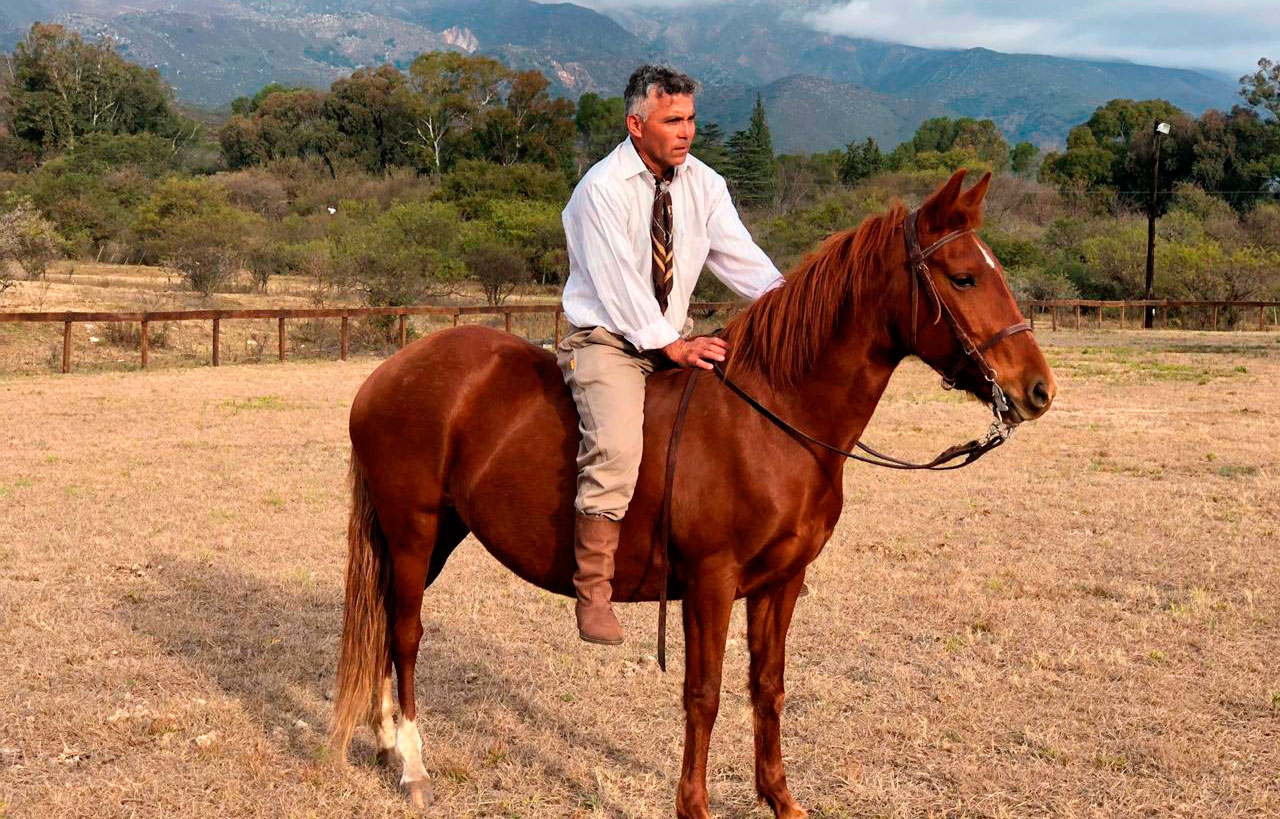
There are many things on which we disagree with regard to the training that is practised in Peru, as well as in almost all places where CPP is bred - among others, the issue of galloping, which many breeders do not teach their CPP - but to explain all these differences would take us beyond the scope of this content, which is to show the essential issues that explain the CPP, such as its history, its morphology, and its levels or mechanics of its airs.
We will only say that everything that is said to be obtained with dressage, in the Peruvian style, is obtained in a clear, forceful and safe way with techniques based on the scientific knowledge provided by Ethology and Learning Theory.
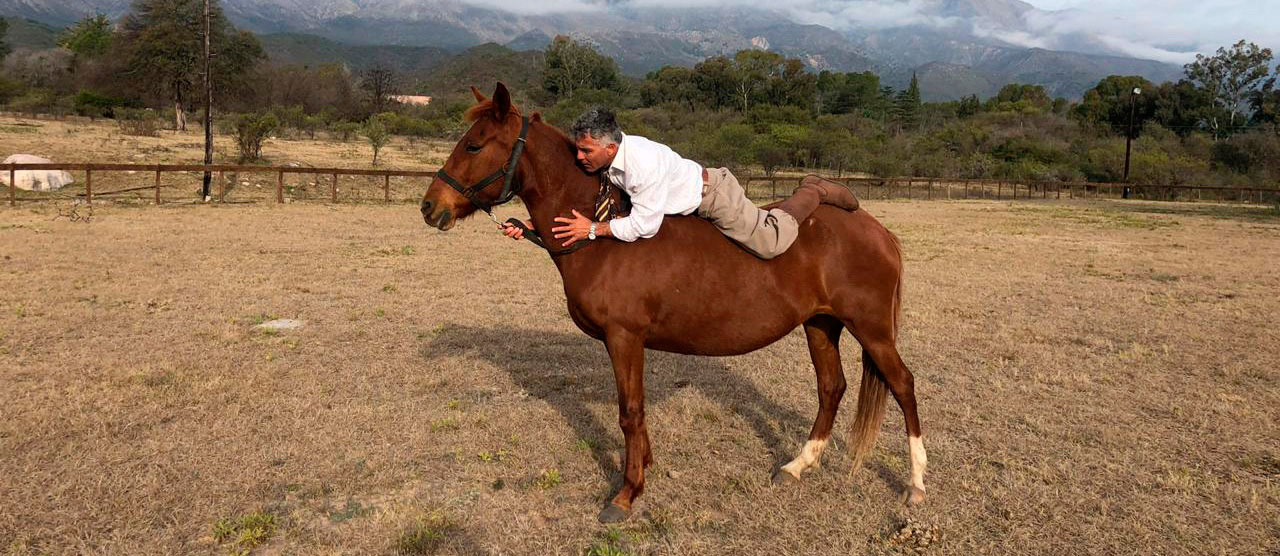
**We hope that this series of articles on the Peruvian Paso Horse has been useful with the information, our experiences and opinions.
Do you have any questions? Leave your message below and we will answer your questions.**
Continúa leyendo
Este artículo es exclusivo para miembros.
To view this blog, please complete the form
Access full content
Comments (0)
No comments yet.


Comments
Leave your comment