
How horses learn (part I)
Have you ever wondered why horses respond to the signals or aids of the rider? Walking at a pace, trotting, galloping, jumping a fence...
On this occasion we want to show you the art of training horses from our experience. We explain how we teach our Peruvian Paso horses to follow any of our instructions.
Introduction to horse training
When you start riding, it seems natural that your horse should start moving forward if you press down with your legs. Or that it should stop when you pull on the reins. Even that it should turn if you pull on just one.
But these seemingly natural responses are not something innate in the horse. Someone had to teach it before you got on it.
It is important to emphasise that these movements are already incorporated into the horse's genetics. They are part of its behaviour. The horse knows how to move at a walk, a trot or a canter at will. It jumps, stops and turns of its own accord.
In fact, a newborn foal is capable of standing on its legs and, in a short space of time, begins to walk alongside its mother and to gallop alongside her if it has to flee from danger.
But when we talk about training a horse, we mean getting it to carry out these movements, already imprinted in its neural connections, when we are mounted on it and give it a specific signal.
In other words, we condition its natural movements so that it performs them when we give it a specific indication.
This action of linking a signal with a response from the horse, such as walking, jumping or galloping, is what we call training or breaking in.
And when we say that a horse learns, we mean that it responds to the signals we give it. We communicate with it.
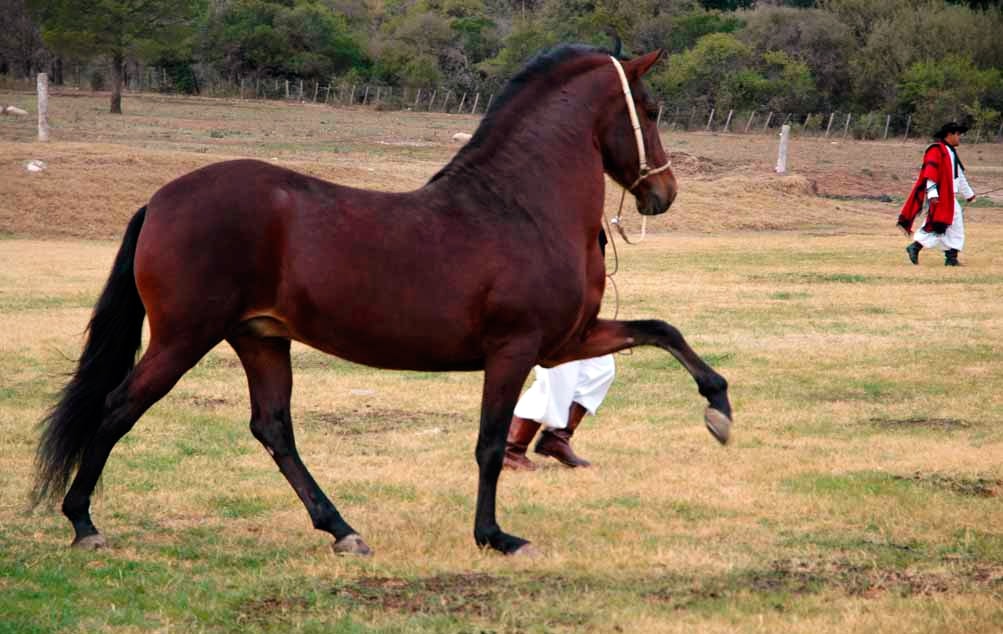
What is the best method for teaching a horse?
This is a great topic of discussion since man first climbed on a horse. The question is very extensive, since the horse also learns by habituation.
The fact of letting oneself be mounted is a clear example.
When we get on a horse, we don't give it any specific signal, but when we try to get on it, provided we do it in a certain way, it will bear us without rearing up or responding by trying to escape.
When man began to ride horses, the training of horses was resolved in very different ways and with different results.
Unfortunately, the indiscriminate use of violence prevailed almost overwhelmingly. This painful situation continues to this day in certain cases, especially with field trainers.
However, other cultures used observation to try to interpret how they could familiarize the horse with humans. Along the way, they detected that the most important thing was to prevent the horse from trying to flee. This is the outward expression of the strongest emotion that these animals experience: fear.
The horse has developed this flight instinct with great sensitivity in its evolutionary process, which has allowed it to survive in the face of its predators to this day.
What science contributes to the knowledge of horses
There have been great masters of horsemanship since Genofontes (450 BC), a Greek military man, historian and philosopher, who wrote the two oldest and most famous treatises on horsemanship, Hippike and Hipparchikós. In them he laid the foundations for the breaking in and training of young horses.
Later, between the 16th, 17th, 18th and 19th centuries, masters of the stature of Federico Grisone, Count Cesare Fiaschi, Giovanni Battista Pignatelli, Antoine de Pluvinel, William Cavendish, François Robinchon de la Guérinière and D'Aurbergne François Baucher appeared.
And from them we come to the present day, where we find tamers made in rural tasks and others better known as whisperers, rational or natural.
But the key question remains the same:
What is the correct way to train and tame horses?
In my opinion, this question began to be answered when the subject became the object of scientific study.
The seed that would give rise to the Theory of Learning Applied to Equines was based on three pillars:
- The studies carried out by Ethology, the science that studies animal behavior as a result of its evolutionary process.
- Scientists dedicated to researching the learning mechanisms of horses and other animals, whether or not they have been domesticated by humans.
- The emergence of theories on human behaviorism, such as those explained by Skinner and Watson or the studies of Pavlov, among others.
Currently, we can highlight the Australian zoologist Andrew McLean and McGreevy, who, together with many others, have contributed to laying the foundations of the scientific principles that govern the learning of horses.
Although the techniques of the great masters of horsemanship manage to train horses with application, they have not managed to create a theoretical body based on their principles, as the Theory of Equine Learning does.
The latter makes it possible to explain the complexity of horse behavior in a way that can be passed on to other people.
Furthermore, the scientific work that has laid the foundations for this theory is still in continuous development. It is thanks to these advances that today we can train and teach our horses safely and with their welfare guaranteed.
In this article you will learn the main theoretical foundations in a very summarized way. But if you find it interesting you can find more information in the article “The application of learning theory in horse training”, published by Andrew McLean and Janne Winther Christensen in the Sevier.
I also recommend you turn to the ISES (International Society for Equitation Science), where you can find the principles and concepts that science is contributing to the world of horses thanks to its annual conferences.
My own quest to teach horses
There is a lot of literature on different ways of taming or teaching horses known as Rational Dressage, Natural Dressage, Indian Dressage, etc.
As a horse breeder and founder of Ampascachi, I have studied the fundamentals of all of them, both in books by various authors and by attending courses given by some of them.
I must say that they constitute a great advance, since none of them use violent methods.
But in my opinion, they do not present a complete description of the specific mechanisms of how to teach horses or how to advance in the process of training or breaking a horse step by step.
This caused me a great deal of confusion, until a little over 15 years ago I came across a book by chance that opened my mind and provided me with very clear and concrete concepts, based on scientific evidence, about what horses are like, how they learn and what you can teach them.
I don't mean to say that this book functions like the sacred scriptures, the source where in ancient times man found answers to all the ethical and existential problems he faced. But when I considered the problem with a very solid argument, it gave me the possibility of continuing on that path of science to deepen my knowledge on the subject.
Almost immediately we decided to put these theoretical principles into practice at our Peruvian Paso horse stud farm in Ampascachi.
To do this, we developed a dressage and training protocol based on these principles that immediately began to produce results. We were thrilled to see that the horses were learning without the need to resort to practices of dubious origin, promoted by a few who boast of understanding communication with horses without being able to explain how and why they do it.
Since then we only allow people trained by us in the principles and practices derived from Learning Theory, a subject that is constantly evolving, to train our horses.
The book I am referring to is called: “The Truth About Horses”.
I confess that I found the title somewhat presumptuous, since in science the truth is never reached. It only exists until new knowledge modifies it.
But it was precisely this challenging title that led me to buy the book.
Reading it allowed me to clearly understand, on a scientific basis:
- What the horse's brain is like and how it works.
- The behaviors that are specific to it due to its evolution as a species.
- How horses process learned behaviors.
- How to apply these concepts in practice to obtain a horse that is safe for the rider without neglecting the welfare of the animal.
The principles of learning theory in equine training
As veterinarians do, in order to train horses it is our obligation to know the evolution, behavior and biology of the species.
In this graph we explain in a schematic way the theoretical framework on which the principles of Learning Theory are based.
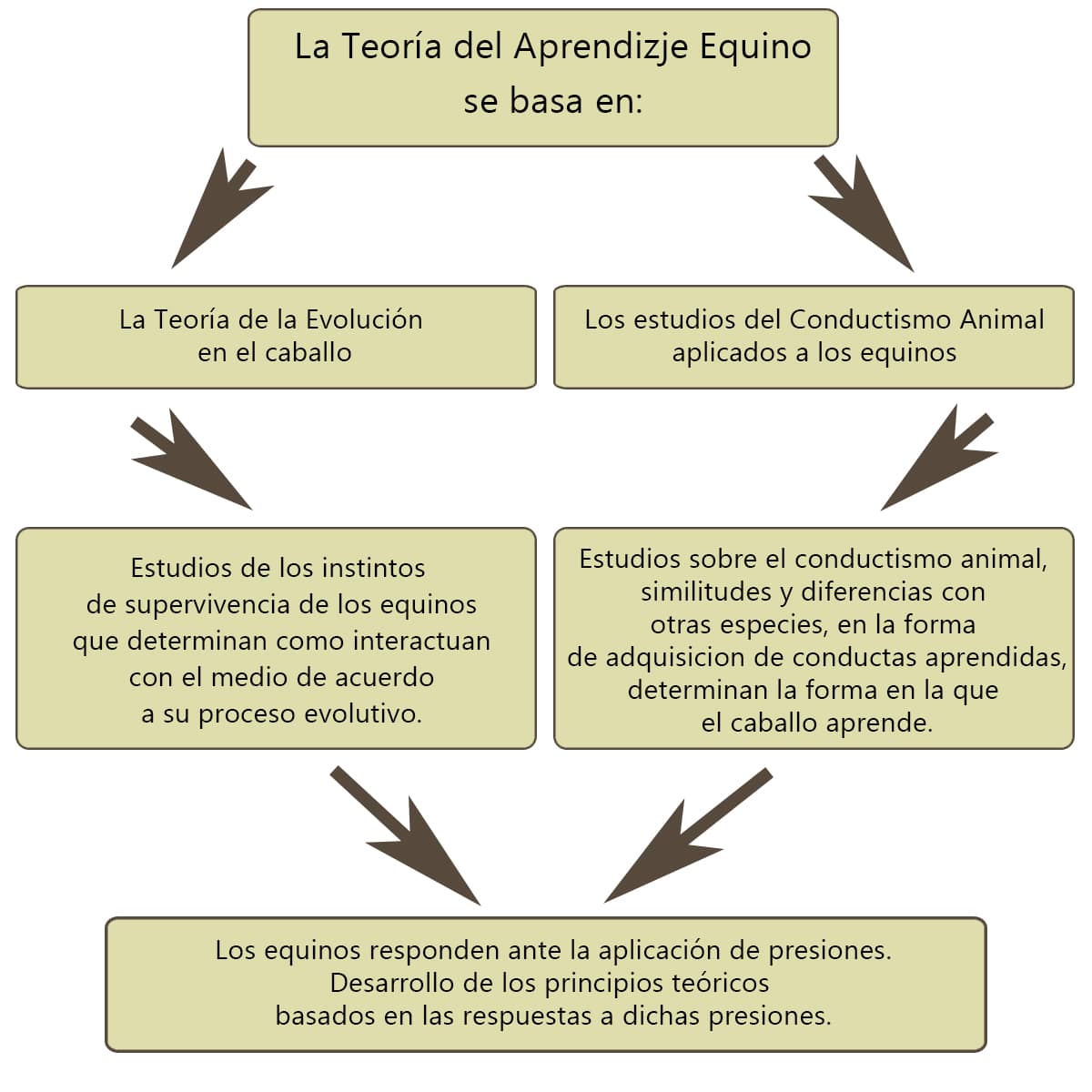
Based on this, we can apply a method of taming and training horses supported by scientifically proven knowledge.
The theory of evolution in the horse
Charles Robert Darwin, the English naturalist, postulated in his theory of evolution that all species of living beings have evolved over time from a common ancestor through a process called natural selection.
Natural selection consists of the differential reproduction of individuals, according to their genetics and generally as a result of a reproductive advantage with respect to the environment.
Natural selection exists when there are differences in biological efficiency between individuals in a population. Biological efficiency can be broken down into components such as survival, fertility, fecundity, etc.
Specifically, equines evolved as prey animals, social animals and herbivores. Their biology is constituted according to these needs. Therefore, they have an integrated flight instinct. So much so, that the foal stands up at birth, a reaction that will allow it to run in case a predator appears.
If we reflect on this fact, we can deduce that there are marked differences between the human brain and that of the horse, due to the fact that their evolutionary processes were very different.
The horse's brain
If we reflect on this fact, we can deduce that there are marked differences between the human brain and the horse's brain, due to the fact that their evolutionary processes were very different.
This anatomical and functional differentiation of the horse's brain means that this animal does not think or reason like humans. It is genetically programmed for its place in evolution.
Therefore, it is necessary to understand which processes do occur in the equine brain (see images 2 and 3).
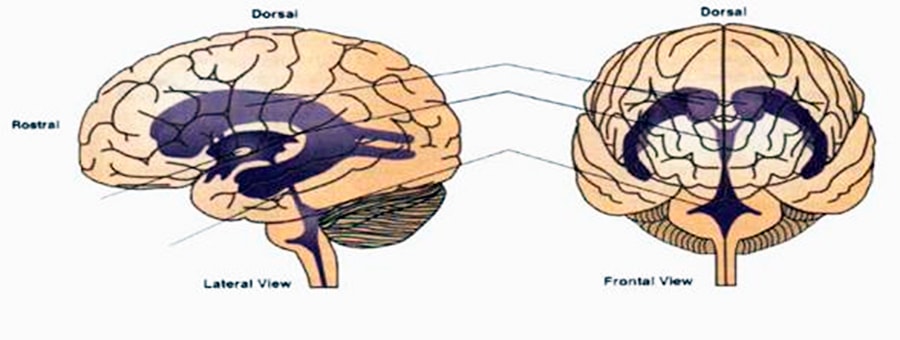
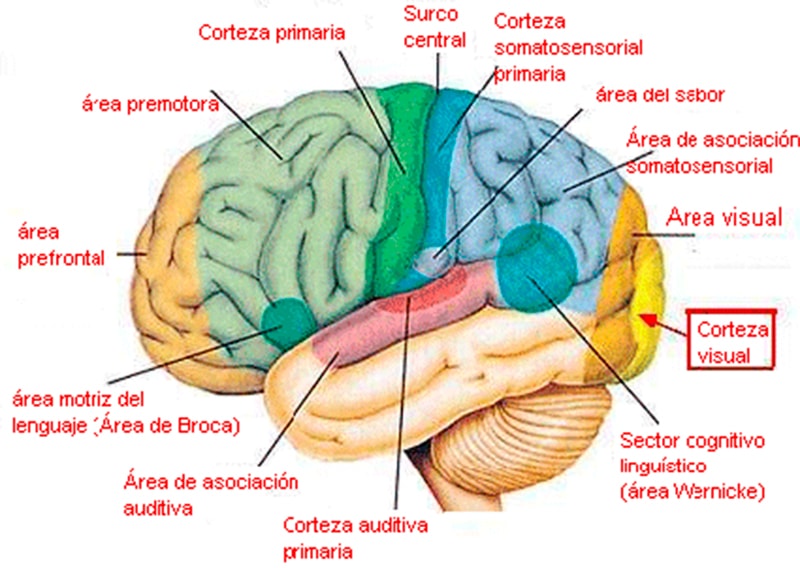 The criteria used to indicate the existence of higher mental faculties, including a basic reasoning capacity in animals, are as follows:
- Imitating a motor behavior performed by another animal.
- Solving new problems on the first attempt.
- Finding shortcuts in a labyrinth (spatial location).
- The ability to form abstract concepts.
In fact, the horse does not have any of these characteristics. However, it has developed others that are essential for its survival, such as the repetition of movements or the generation of habits:
- Habits that allow for immediate reactions.
- Stable movements that only change with conditioning.
- Habits that are learned quickly, something essential for escaping dangers as soon as they are born.
- Processes that are more energy efficient compared to higher mental processes, which are much more demanding.
Due to the structure of their brains, equines are incapable of complex thought.
They cannot distinguish between good and evil. They neither want nor hate in the way that humans do. And, therefore, they can never see us humans as one of their own kind.
The horse, on the other hand, can feel fear. It experiences emotions and quickly learns to get used to them.
These are evolutionary characteristics that you must understand and assimilate before undertaking dressage in accordance with them.
The instincts of equines
Flight
Among the instincts that horses possess, such as feeding, fighting or reproduction, the instinct to flee is the most entrenched as they are prey animals.
This instinct manifests itself whenever there is a need to escape danger or get out of an uncomfortable situation. And the more the animal practices this behavior, the more the nerve connections in its brain that trigger it become stronger.
Therefore, this instinct is what most affects training.
It always manifests itself as the limbs being set in motion. Therefore, reducing or stopping this response through training will disconnect these associations and allow us to obtain a horse that responds to our stimuli accurately.
The flight instinct varies greatly between different breeds of horse. It usually manifests itself through tension in the body and muscles.
The signs of slight tension to look out for are:
- A sunken and tense back.
- A higher carriage of the neck and head.
- Eyes wide open.
- Noses more open.
- A tail that is raised, raised higher or between the buttocks.
- Faster and shorter strides.
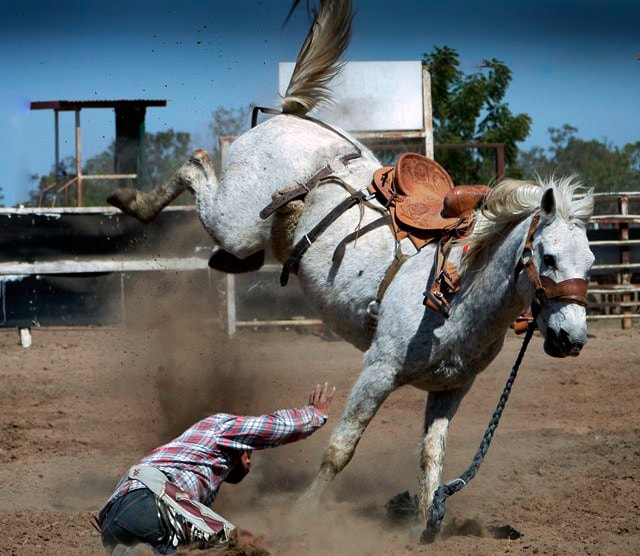
If these signs persist, erratic behaviour may appear such as:
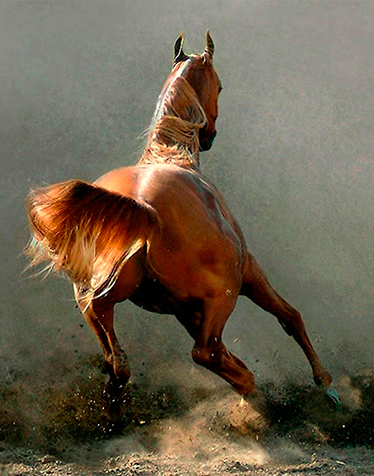
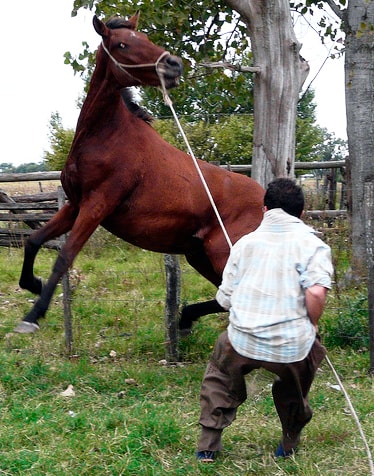
- Fright, rapid lateral movements.
- Breaking loose, stampeding and fleeing.
- Bucking, where the horse puts its head between its hands and kicks.
- Standing on two legs, where the horse stands on its hind legs.
All these reactions should be avoided through correct training (see images 3, 5 and 6 for examples).
 ## Hierarchy
Horses live in groups or herds, which makes them feel secure. But this also increases competition when it comes to getting scarce resources, such as food or mates.
For this reason, within each group there is a certain hierarchy that manifests itself as an instinct of domination of some over others. Confrontation manifests itself with displays and threats that do not usually go beyond simple demonstrations and are common in wild horses that live in freedom.
They instinctively know each one's place within the group or herd and behave accordingly.
This question of dominance and submission can lead some members of the herd to want to bypass the social hierarchies. Something that many trainers in the equestrian world have tried to use to their advantage during training.
These types of trainers argue that horses should be trained to think that we are the boss or leader of the herd (a concept derived from the idea of dominance). But this is not the case. A horse will never see us in that way. Let's not forget that their brain is different and they cannot see us as an equal.
For example, when a group of horses is frightened and flees as a herd, they never move in the same direction as their “human leader”. The first problem this person would have would be to catch up with the speed of the herd and maintain enough distance to avoid being trampled.
With this example I want to show, ironically, that interactions between man and horse cannot be based on the idea that the horse sees the man as a “leader”.
This idea of dominant hierarchies for training horses leads to the concept that “the horse must learn who is in charge and know its place.
A thought that has no scientific basis. It has not been proven that the behaviors that arise from the relationships between horses in a herd can be replicated in the interaction of the horse with humans.
Flight distance
This is the maximum approach distance that a horse will allow a potential aggressor to get to before fleeing. The closer the human gets to a horse, the greater the horse's tendency to flee.
During training you must prevent this from happening. If the horse escapes, do not back down, but take a step forward.
Any maneuver the horse tries to get away will be reinforced if the trainer moves away and will be repeated under similar conditions.
On many occasions the horse tries to flee, but as trainers we cannot let it express this action, always taking care of safety.
For example, if you want to touch the horse's head, especially in the area of the ears or on its forehead, it will try to move its head in all directions, trying to make you withdraw your hand.
In these cases, you should do just the opposite. Avoid removing your hand until the horse gets used to it.
In short, if the horse manages to run away or move away, that behavior will be reinforced because it has relieved the strongest emotion: fear. Therefore, with just two or three repetitions it will be indelibly etched.
The herd instinct
The herd instinct is the natural tendency of equines to live and move in family groups through a certain territory.
This habit can be useful in training horses, for example, to teach them to cross a stream or go through difficult places.
For this to happen it must be very close, practically on the rump of another horse. As a horse separates from the herd this instinct diminishes.
A reflection on the horse
In general, horse lovers have a special love for them. That is why we should reflect on the following:
When you truly love someone, you must accept them as they are. Expect from them what they can do and stop demanding from them what they cannot.
Scientific evidence indicates that the horse does not have a brain capable of any kind of complex or basic reasoning. But it does have a brain adapted to its condition as a gregarious herbivore and this has given it the capacity for habitual behavior. These have some advantages over complex mental processes and we should take them into account so that our interaction with them does not cause them suffering or discomfort.
Some advantages of habitual behavior over complex reasoning are:
- Habitual behavior allows for immediate reactions, something essential for a prey animal.
- Habits are very stable and can only be modified through conditioning.
- Habits are learned more quickly, something important for species with the need to escape from birth.
- Habit is more economical, in energy terms, than the generation of complex reasoning and understanding.
Comments (0)
No comments yet.
You might also like
Dr. Camie Heleski: Equine behaviour and welfare
Dr. Uta König von Borstel: Equitation science applied to horse welfare and breeding
Dr. Paul McGreevy: specialist in horse behaviour and welfare

Ylvie Fros – Horse trainer in the Netherlands
How do horses learn? - Part II

Comments
Leave your comment